which of the following is true about the base (b) of a logarithmic function?\n(b > 0) and (b = 1)\n(b > 0)…
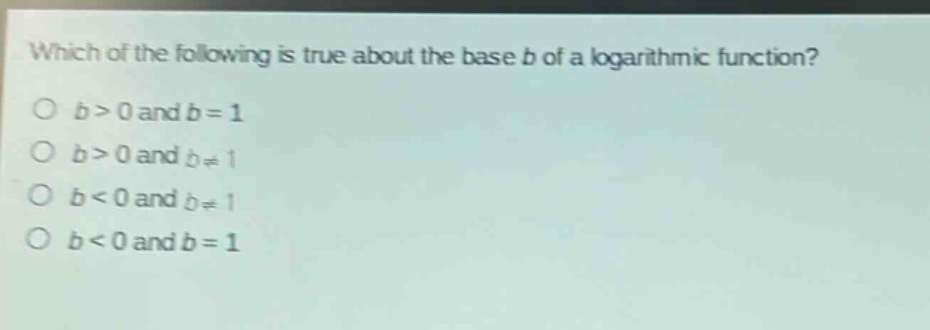
which of the following is true about the base (b) of a logarithmic function?\n(b > 0) and (b = 1)\n(b > 0) and (b\neq1)\n(b < 0) and (b\neq1)\n(b < 0) and (b = 1)
Answer
Explanation:
Step1: Definición de función logarítmica
La función logarítmica está definida como $y = \log_b(x)$ donde $b$ es la base. La base $b$ de una función logarítmica debe ser mayor que 0 y distinta de 1. Si $b = 1$, la función no es bien - definida ya que $1^y$ siempre es 1 para cualquier $y$, y si $b<0$, la función tendrá valores complejos para muchos valores reales de $x$.
Answer:
$b>0$ and $b\neq1$ (segunda opción)