which of the following is a vertical stretch of the parent function (f(x)=x^{2})?\n(y = 4x^{2})\n(y=\frac{1}{…
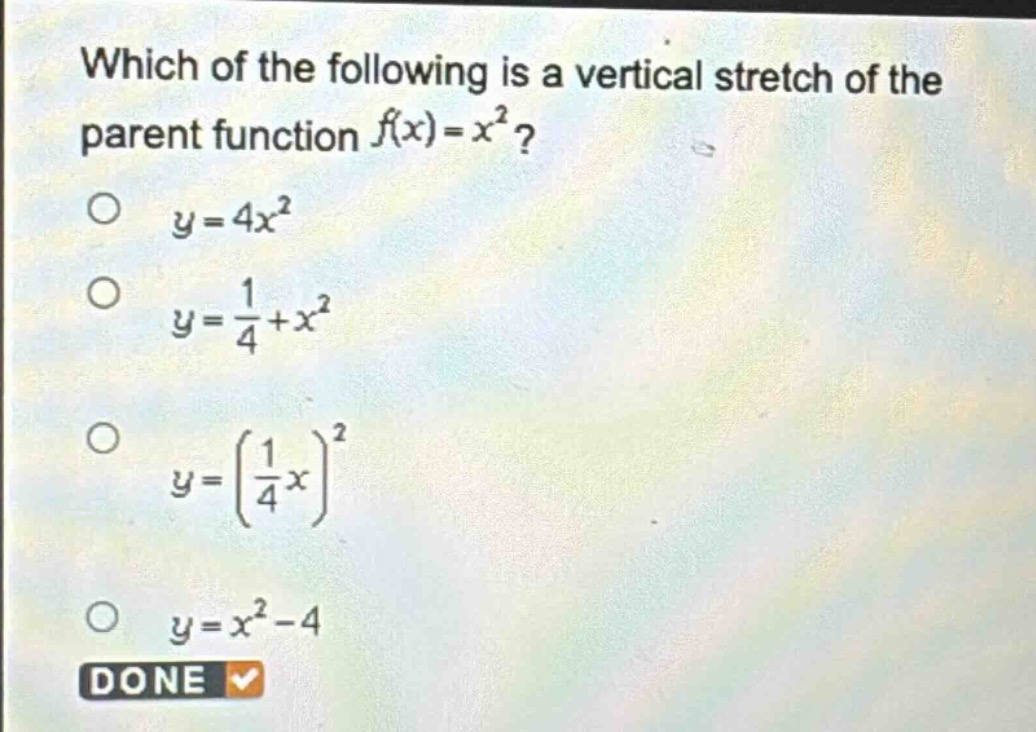
which of the following is a vertical stretch of the parent function (f(x)=x^{2})?\n(y = 4x^{2})\n(y=\frac{1}{4}+x^{2})\n(y = (\frac{1}{4}x)^{2})\n(y=x^{2}-4)
Answer
Explanation:
Step1: Recall vertical - stretch rule
For a function $y = f(x)$, a vertical stretch by a factor $a$ ($a>1$) is given by $y = a\cdot f(x)$. The parent function is $f(x)=x^{2}$.
Step2: Analyze each option
- Option 1: $y = 4x^{2}=4\cdot f(x)$. Here, $a = 4>1$, so it is a vertical stretch.
- Option 2: $y=\frac{1}{4}+x^{2}$ is a vertical shift of $\frac{1}{4}$ units up of the parent - function $y = x^{2}$.
- Option 3: $y = (\frac{1}{4}x)^{2}=\frac{1}{16}x^{2}$ is a horizontal stretch of the parent - function $y = x^{2}$.
- Option 4: $y=x^{2}-4$ is a vertical shift of 4 units down of the parent - function $y = x^{2}$.
Answer:
$y = 4x^{2}$