if $\frac{1}{64}=4^{2s - 1}cdot16^{2s+2}$, what is the value of s?\n-1\n0\n1\nno solution
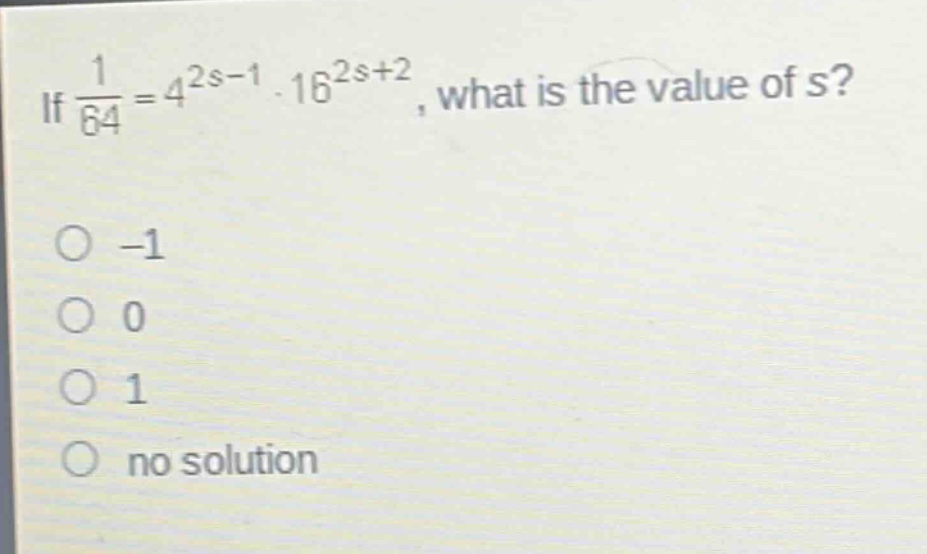
if $\frac{1}{64}=4^{2s - 1}cdot16^{2s+2}$, what is the value of s?\n-1\n0\n1\nno solution
Answer
Explanation:
Step1: Rewrite bases as powers of 2
Since $\frac{1}{64}=2^{-6}$, $4 = 2^{2}$, and $16=2^{4}$, the equation $\frac{1}{64}=4^{2s - 1}\cdot16^{2s+2}$ can be rewritten as $2^{-6}=(2^{2})^{2s - 1}\cdot(2^{4})^{2s+2}$.
Step2: Apply power - of - a - power rule
Using the rule $(a^{m})^{n}=a^{mn}$, we get $2^{-6}=2^{2(2s - 1)}\cdot2^{4(2s+2)}$.
Step3: Simplify exponents
$2^{-6}=2^{4s-2}\cdot2^{8s + 8}$.
Step4: Apply product rule of exponents
Using the rule $a^{m}\cdot a^{n}=a^{m + n}$, we have $2^{-6}=2^{(4s-2)+(8s + 8)}$.
Step5: Combine like terms in exponent
$2^{-6}=2^{4s-2 + 8s+8}=2^{12s + 6}$.
Step6: Set exponents equal
Since the bases are the same, we set the exponents equal: $-6=12s+6$.
Step7: Solve for s
Subtract 6 from both sides: $-6-6=12s$, so $-12 = 12s$. Then divide both sides by 12: $s=-1$.
Answer:
A. -1