if (f(x)=\frac{1}{9}x - 2), what is (f^{-1}(x))?\n(f^{-1}(x)=9x + 18)\n(f^{-1}(x)=\frac{1}{9}x+2)\n(f^{-1}(x)…
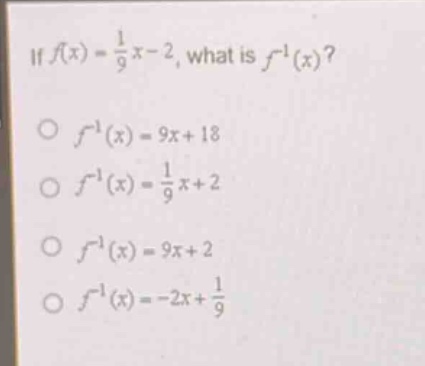
if (f(x)=\frac{1}{9}x - 2), what is (f^{-1}(x))?\n(f^{-1}(x)=9x + 18)\n(f^{-1}(x)=\frac{1}{9}x+2)\n(f^{-1}(x)=9x + 2)\n(f^{-1}(x)=-2x+\frac{1}{9})
Answer
Answer:
A. $f^{-1}(x)=9x + 18$
Explanation:
Step1: Let $y = f(x)$
$y=\frac{1}{9}x - 2$
Step2: Swap $x$ and $y$
$x=\frac{1}{9}y - 2$
Step3: Solve for $y$
Add 2 to both sides: $x + 2=\frac{1}{9}y$. Then multiply both sides by 9, we get $y=9x + 18$. So $f^{-1}(x)=9x + 18$.