if $c(x)=\frac{5}{x - 2}$ and $d(x)=x + 3$, what is the domain of $(cd)(x)$?\no all real values of $x$\no…
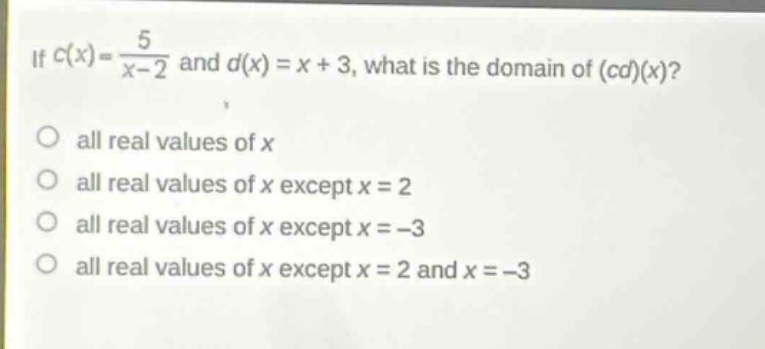
if $c(x)=\frac{5}{x - 2}$ and $d(x)=x + 3$, what is the domain of $(cd)(x)$?\no all real values of $x$\no all real values of $x$ except $x = 2$\no all real values of $x$ except $x=-3$\no all real values of $x$ except $x = 2$ and $x=-3$
Answer
Explanation:
Step1: Find the product function
$(cd)(x)=c(x)\times d(x)=\frac{5}{x - 2}\times(x + 3)=\frac{5(x + 3)}{x - 2}$
Step2: Determine the domain - undefined values
The function is undefined when the denominator is 0. Set $x-2=0$, we get $x = 2$.
Answer:
all real values of x except x = 2