f(x) = (\\frac{2}{5})^x\nwhich statement about f(x) and its translation, g(x), is true?\ng(x) =…
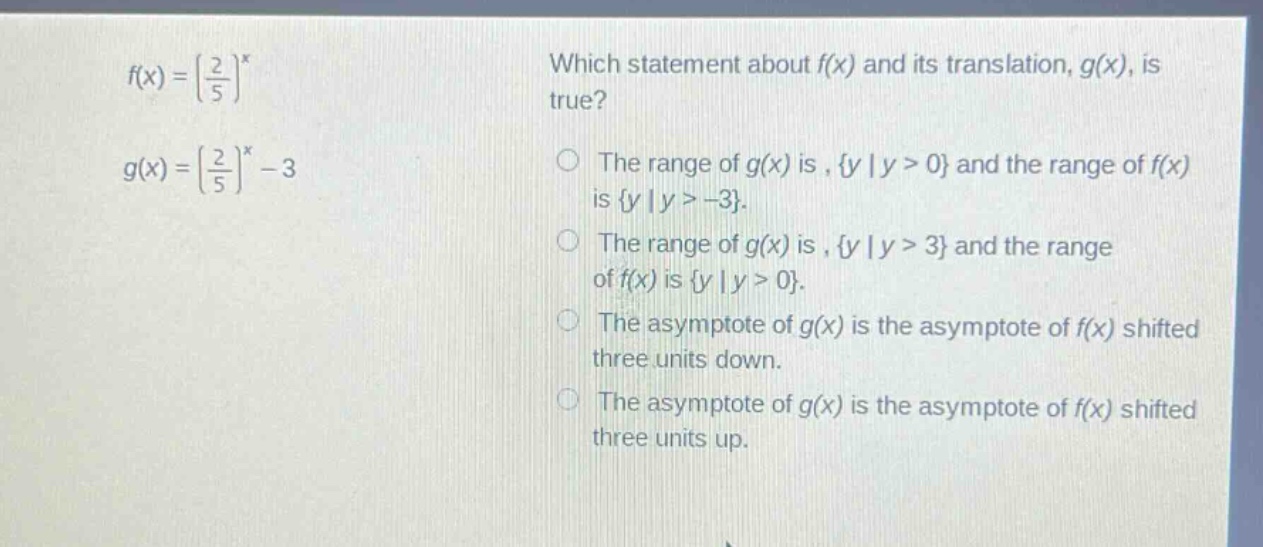
f(x) = (\\frac{2}{5})^x\nwhich statement about f(x) and its translation, g(x), is true?\ng(x) = (\\frac{2}{5})^x - 3\nthe range of g(x) is, {y | y > 0} and the range of f(x) is {y | y > -3}.\nthe range of g(x) is, {y | y > 3} and the range of f(x) is {y | y > 0}.\nthe asymptote of g(x) is the asymptote of f(x) shifted three units down.\nthe asymptote of g(x) is the asymptote of f(x) shifted three units up.
Answer
Explanation:
Step1: Recall the properties of exponential functions
For the exponential function $f(x) = a^x$ ($a>0,a\neq1$), the range is $(0,+\infty)$ and the horizontal - asymptote is $y = 0$. For $f(x)=\left(\frac{2}{5}\right)^x$, the range is ${y|y > 0}$ and the horizontal asymptote is $y = 0$.
Step2: Analyze the transformation of $g(x)$
The function $g(x)=\left(\frac{2}{5}\right)^x-3$ is a vertical translation of $f(x)=\left(\frac{2}{5}\right)^x$ by 3 units down. When we translate a function $y = f(x)$ down by $k$ units to get $y=f(x)-k$, the range of $y = f(x)$ which is $(0,+\infty)$ becomes $( - k,+\infty)$. So the range of $g(x)$ is ${y|y>-3}$, and the horizontal asymptote of $f(x)$ which is $y = 0$ is shifted 3 units down to $y=-3$.
Answer:
The asymptote of $g(x)$ is the asymptote of $f(x)$ shifted three units down.