the function d(t) defines a travelers distance from home, in miles, as a function of time, in…
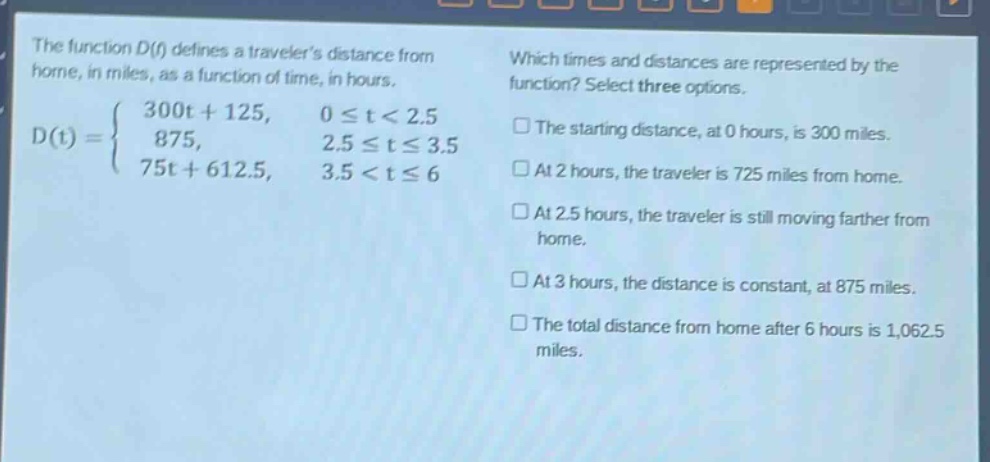
the function d(t) defines a travelers distance from home, in miles, as a function of time, in hours.\nd(t)=\begin{cases}300t + 125, & 0leq t<2.5\\875, & 2.5leq tleq3.5\\75t + 612.5, & 3.5<tleq6end{cases}\nwhich times and distances are represented by the function? select three options.\n□ the starting distance, at 0 hours, is 300 miles.\n□ at 2 hours, the traveler is 725 miles from home.\n□ at 2.5 hours, the traveler is still moving farther from home.\n□ at 3 hours, the distance is constant, at 875 miles.\n□ the total distance from home after 6 hours is 1,062.5 miles.
Answer
Explanation:
Step1: Check starting distance
When $t = 0$, use $D(t)=300t + 125$. Substitute $t = 0$ into the formula: $D(0)=300\times0+125 = 125$ miles, so the statement "The starting distance, at 0 hours, is 300 miles" is false.
Step2: Calculate distance at $t = 2$
When $t = 2$ and $0\leq t<2.5$, use $D(t)=300t + 125$. Substitute $t = 2$ into the formula: $D(2)=300\times2+125=600 + 125=725$ miles. So the statement "At 2 hours, the traveler is 725 miles from home" is true.
Step3: Analyze at $t = 2.5$
When $t = 2.5$, $D(t)=875$ (since $2.5\leq t\leq3.5$), the traveler's distance stops increasing and remains at 875 miles, so the statement "At 2.5 hours, the traveler is still moving farther from home" is false.
Step4: Analyze at $t = 3$
When $t = 3$ and $2.5\leq t\leq3.5$, $D(t)=875$. So the statement "At 3 hours, the distance is constant, at 875 miles" is true.
Step5: Calculate distance at $t = 6$
When $t = 6$ and $3.5<t\leq6$, use $D(t)=75t + 612.5$. Substitute $t = 6$ into the formula: $D(6)=75\times6+612.5=450+612.5 = 1062.5$ miles. So the statement "The total distance from home after 6 hours is 1,062.5 miles" is true.
Answer:
At 2 hours, the traveler is 725 miles from home. At 3 hours, the distance is constant, at 875 miles. The total distance from home after 6 hours is 1,062.5 miles.