which function has a domain of (xgeq5) and a range of (yleq3)?\n(y = sqrt{x - 5}+3)\n(y=sqrt{x +…
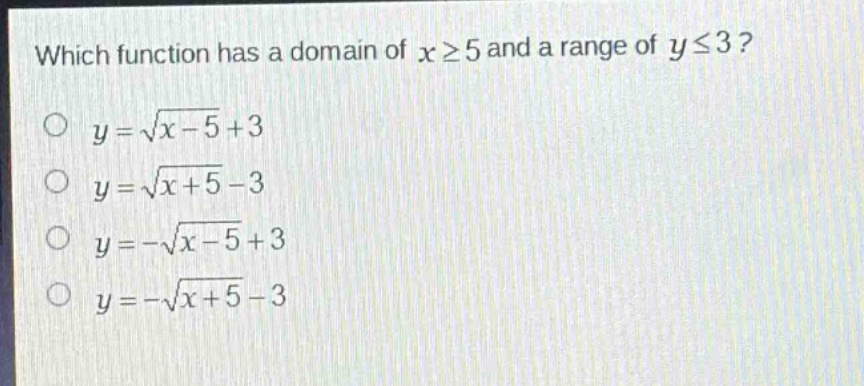
which function has a domain of (xgeq5) and a range of (yleq3)?\n(y = sqrt{x - 5}+3)\n(y=sqrt{x + 5}-3)\n(y=-sqrt{x - 5}+3)\n(y=-sqrt{x + 5}-3)
Answer
Explanation:
Step1: Recall domain - finding rule for square - root functions
For a function of the form $y = \sqrt{u}$, the expression under the square - root $u\geq0$.
Step2: Analyze the domain of each option
- For $y=\sqrt{x - 5}+3$, we set $x−5\geq0$, so $x\geq5$.
- For $y=\sqrt{x + 5}-3$, we set $x + 5\geq0$, so $x\geq - 5$.
- For $y=-\sqrt{x - 5}+3$, we set $x−5\geq0$, so $x\geq5$.
- For $y=-\sqrt{x + 5}-3$, we set $x + 5\geq0$, so $x\geq - 5$.
Step3: Recall range - finding rule for square - root functions
The square - root function $\sqrt{u}\geq0$ for $u\geq0$.
Step4: Analyze the range of each option with $x\geq5$
- For $y=\sqrt{x - 5}+3$, since $\sqrt{x - 5}\geq0$, then $y=\sqrt{x - 5}+3\geq3$.
- For $y=\sqrt{x + 5}-3$, since $\sqrt{x + 5}\geq0$, then $y=\sqrt{x + 5}-3\geq - 3$.
- For $y=-\sqrt{x - 5}+3$, since $\sqrt{x - 5}\geq0$, then $-\sqrt{x - 5}\leq0$, and $y=-\sqrt{x - 5}+3\leq3$.
- For $y=-\sqrt{x + 5}-3$, since $\sqrt{x + 5}\geq0$, then $-\sqrt{x + 5}\leq0$, and $y=-\sqrt{x + 5}-3\leq - 3$.
Answer:
$y =-\sqrt{x - 5}+3$