a function of the form $f(x)=ab^{x}$ is modified so that the $b$ value remains the same but the $a$ value is…
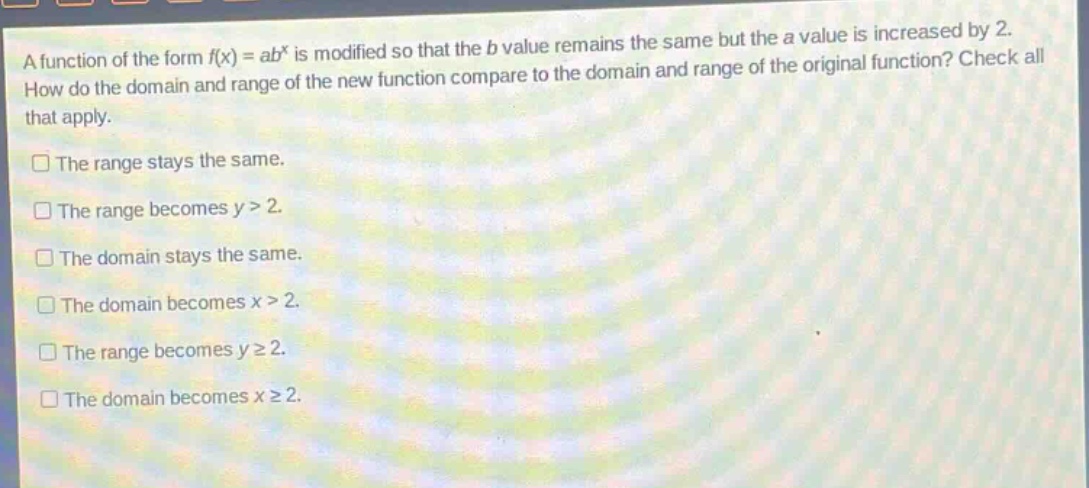
a function of the form $f(x)=ab^{x}$ is modified so that the $b$ value remains the same but the $a$ value is increased by 2. how do the domain and range of the new function compare to the domain and range of the original function? check all that apply.\nthe range stays the same.\nthe range becomes $y > 2$.\nthe domain stays the same.\nthe domain becomes $x > 2$.\nthe range becomes $ygeq2$.\nthe domain becomes $xgeq2$.
Answer
Explanation:
Step1: Recall domain and range of exponential function
The original function is $f(x)=ab^{x}$, and the new - function is $g(x)=(a + 2)b^{x}$. For an exponential function of the form $y = cb^{x}$ ($c\neq0$, $b>0,b\neq1$), the domain is all real numbers, i.e., $x\in(-\infty,\infty)$. Changing the coefficient $c$ (from $a$ to $a + 2$) does not affect the values of $x$ for which the function is defined.
Step2: Analyze the range
The range of $y = ab^{x}$:
- If $a>0$, the range is $y>0$. If $a<0$, the range is $y < 0$. When we change $a$ to $a + 2$, the sign of the non - zero coefficient of $b^{x}$ does not change in a way that would shift the range vertically. The range of $y=(a + 2)b^{x}$ has the same form as the range of $y = ab^{x}$. For example, if $a>0$, both $ab^{x}$ and $(a + 2)b^{x}$ have a range of $y>0$; if $a<0$, both have a range of $y<0$.
Answer:
The range stays the same. The domain stays the same.