the function $f(x)=\frac{3}{4}(10)^{-x}$ is reflected across the x - axis to create the function $g(x)$…
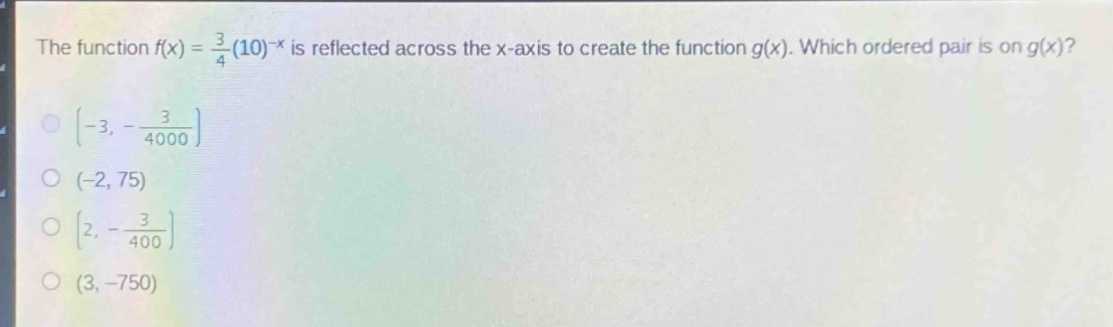
the function $f(x)=\frac{3}{4}(10)^{-x}$ is reflected across the x - axis to create the function $g(x)$. which ordered pair is on $g(x)$?\n$(-3,-\frac{3}{4000})$\n$(-2,75)$\n$(2,-\frac{3}{400})$\n$(3,-750)$
Answer
Explanation:
Step1: Find the formula for g(x)
When a function $y = f(x)$ is reflected across the x - axis, the new function is $g(x)=-f(x)$. Given $f(x)=\frac{3}{4}(10)^{-x}$, then $g(x)=-\frac{3}{4}(10)^{-x}$.
Step2: Check each option
Option 1: For $x = - 3$
$g(-3)=-\frac{3}{4}(10)^{-(-3)}=-\frac{3}{4}\times10^{3}=-\frac{3000}{4}=- 750\neq-\frac{3}{4000}$.
Option 2: For $x=-2$
$g(-2)=-\frac{3}{4}(10)^{-(-2)}=-\frac{3}{4}\times10^{2}=-\frac{300}{4}=-75\neq75$.
Option 3: For $x = 2$
$g(2)=-\frac{3}{4}(10)^{-2}=-\frac{3}{4}\times\frac{1}{100}=-\frac{3}{400}$.
Option 4: For $x = 3$
$g(3)=-\frac{3}{4}(10)^{-3}=-\frac{3}{4}\times\frac{1}{1000}=-\frac{3}{4000}\neq - 750$.
Answer:
C. $(2,-\frac{3}{400})$