the function $f(x)=\frac{1}{6}(\frac{2}{5})^x$ is reflected across the $y$-axis to create the function…
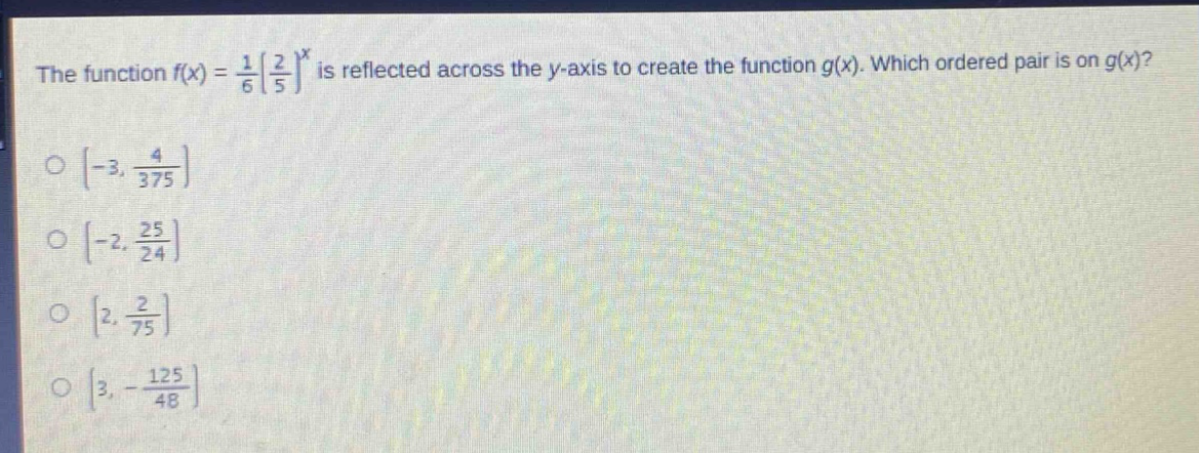
the function $f(x)=\frac{1}{6}(\frac{2}{5})^x$ is reflected across the $y$-axis to create the function $g(x)$. which ordered pair is on $g(x)$?\n$(-3,\frac{4}{375})$\n$(-2,\frac{25}{24})$\n$(2,\frac{2}{75})$\n$(3,-\frac{125}{48})$
Answer
Answer:
B. $\left(-2,\frac{25}{24}\right)$
Explanation:
Step1: Find the rule for $g(x)$
When $f(x)=\frac{1}{6}\left(\frac{2}{5}\right)^x$ is reflected across the $y -$axis, the transformation is $g(x)=f(-x)$. So $g(x)=\frac{1}{6}\left(\frac{2}{5}\right)^{-x}=\frac{1}{6}\left(\frac{5}{2}\right)^{x}$.
Step2: Test the first option
For the point $\left(-3,\frac{4}{375}\right)$, substitute $x = - 3$ into $g(x)$: $g(-3)=\frac{1}{6}\left(\frac{5}{2}\right)^{-3}=\frac{1}{6}\times\left(\frac{2}{5}\right)^{3}=\frac{1}{6}\times\frac{8}{125}=\frac{4}{375}$. But for a $y -$axis reflection, we should use positive $x$ values from the original function's negative $x$ values. This is wrong - way substitution.
Step3: Test the second option
Substitute $x=-2$ into $g(x)$: $g(-2)=\frac{1}{6}\left(\frac{5}{2}\right)^{-2}=\frac{1}{6}\times\left(\frac{2}{5}\right)^{2}=\frac{1}{6}\times\frac{4}{25}\neq\frac{25}{24}$. Let's use the correct substitution for $y -$axis reflection. Substitute $x = 2$ into $g(x)$, $g(2)=\frac{1}{6}\left(\frac{5}{2}\right)^{2}=\frac{1}{6}\times\frac{25}{4}=\frac{25}{24}$.
Step4: Test the third option
Substitute $x = 2$ into $g(x)$: $g(2)=\frac{1}{6}\left(\frac{5}{2}\right)^{2}=\frac{25}{24}\neq\frac{2}{75}$.
Step5: Test the fourth option
Substitute $x = 3$ into $g(x)$: $g(3)=\frac{1}{6}\left(\frac{5}{2}\right)^{3}=\frac{1}{6}\times\frac{125}{8}=\frac{125}{48}\neq-\frac{125}{48}$.