the function h(x) is given below.\nh(x) = {(3, -5), (5, -7), (6, -9), (10, -12), (12, -16)}\nwhich of the…
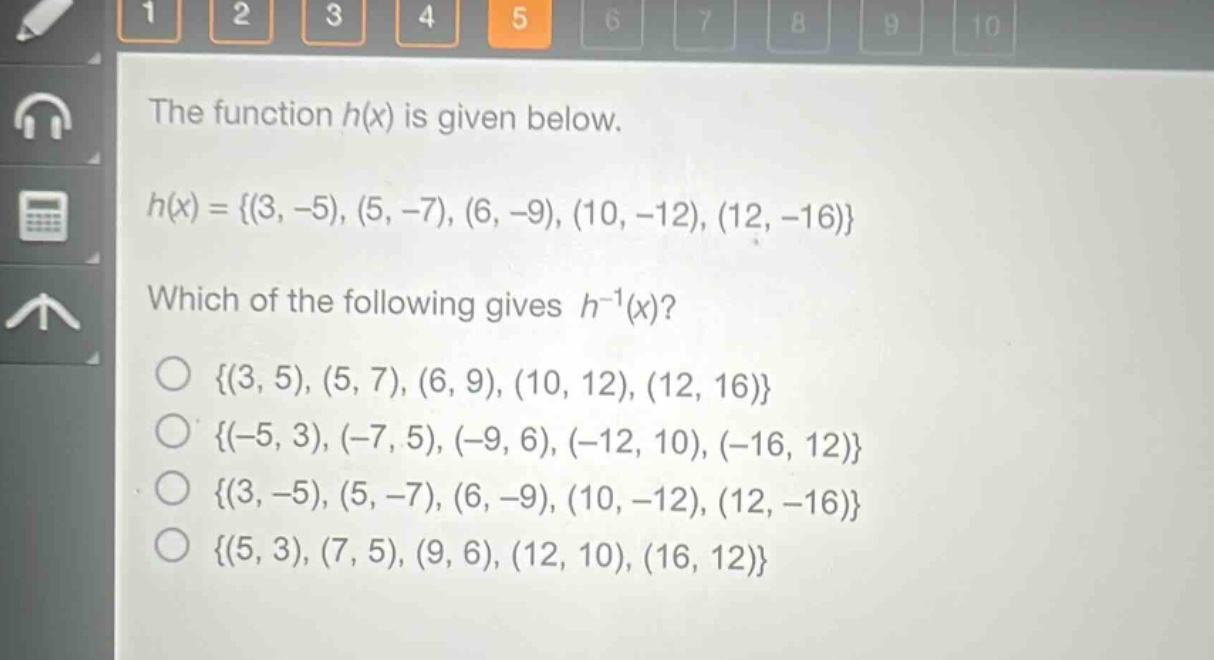
the function h(x) is given below.\nh(x) = {(3, -5), (5, -7), (6, -9), (10, -12), (12, -16)}\nwhich of the following gives h^(-1)(x)?\n{(3, 5), (5, 7), (6, 9), (10, 12), (12, 16)}\n{(-5, 3), (-7, 5), (-9, 6), (-12, 10), (-16, 12)}\n{(3, -5), (5, -7), (6, -9), (10, -12), (12, -16)}\n{(5, 3), (7, 5), (9, 6), (12, 10), (16, 12)}
Answer
Explanation:
Step1: Recall inverse - function concept
The inverse of a function (h(x)) swaps the (x) and (y) values of the ordered - pairs in (h(x)). If (h(x)={(a,b),(c,d),(e,f),(g,h),(i,j)}), then (h^{-1}(x)={(b,a),(d,c),(f,e),(h,g),(j,i)}).
Step2: Swap the ordered - pairs in (h(x))
Given (h(x)={(3, - 5),(5, - 7),(6, - 9),(10, - 12),(12, - 16)}), then (h^{-1}(x)={(-5,3),(-7,5),(-9,6),(-12,10),(-16,12)}).
Answer:
({(-5,3),(-7,5),(-9,6),(-12,10),(-16,12)}) (corresponding to the second option in the multiple - choice list)