which function has the given properties below? the domain is the set of all real numbers. one x - intercept…
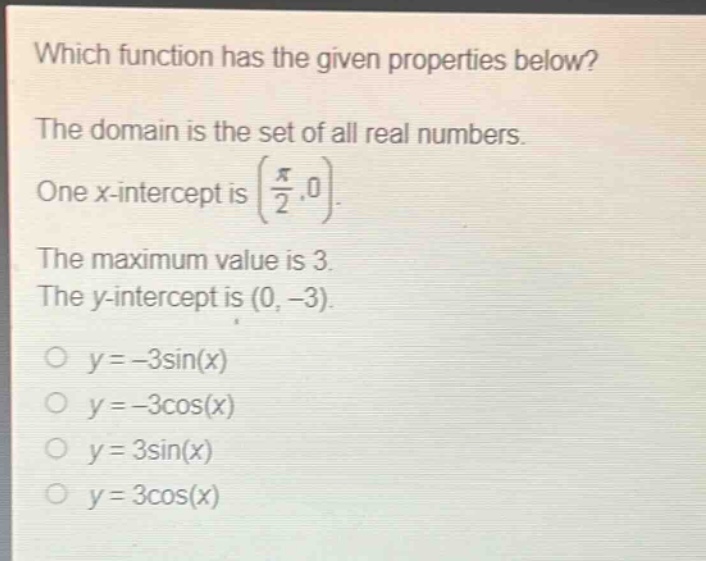
which function has the given properties below? the domain is the set of all real numbers. one x - intercept is $\\left(\\frac{\\pi}{2},0\\right)$. the maximum value is 3. the y - intercept is $(0, - 3)$. $y=-3\\sin(x)$ $y=-3\\cos(x)$ $y = 3\\sin(x)$ $y = 3\\cos(x)$
Answer
Explanation:
Step1: Check domain
All the given functions (y = - 3\sin(x)), (y=-3\cos(x)), (y = 3\sin(x)), (y = 3\cos(x)) have a domain of all real - numbers since there are no restrictions on the input (x) for sine and cosine functions.
Step2: Check x - intercept
For (y=\sin(x)), the x - intercepts are (x = k\pi), (k\in\mathbb{Z}). For (y=\cos(x)), the x - intercepts are (x=\frac{\pi}{2}+k\pi), (k\in\mathbb{Z}). When (x = \frac{\pi}{2}), (\cos(\frac{\pi}{2})=0) and (\sin(\frac{\pi}{2}) = 1). So functions with (\cos(x)) can have an x - intercept at (x=\frac{\pi}{2}).
Step3: Check maximum value
The general form of a sine or cosine function is (y = A\sin(x)) or (y=A\cos(x)), and the amplitude is (|A|). The maximum value of (y = A\sin(x)) and (y = A\cos(x)) is (|A|). We want (|A| = 3), so (A=\pm3).
Step4: Check y - intercept
For (y=-3\cos(x)), when (x = 0), (y=-3\cos(0)=-3\times1=-3). For (y = 3\cos(x)), when (x = 0), (y = 3\cos(0)=3). For (y=-3\sin(x)), when (x = 0), (y=-3\sin(0)=0). For (y = 3\sin(x)), when (x = 0), (y = 3\sin(0)=0).
Answer:
(y=-3\cos(x))