which function is graphed on the right?\n$y = 2^{x + 3}-2$\n$y = 2^{x - 3}+2$\n$y = 2^{x - 2}+3$\n$y = 2^{x…
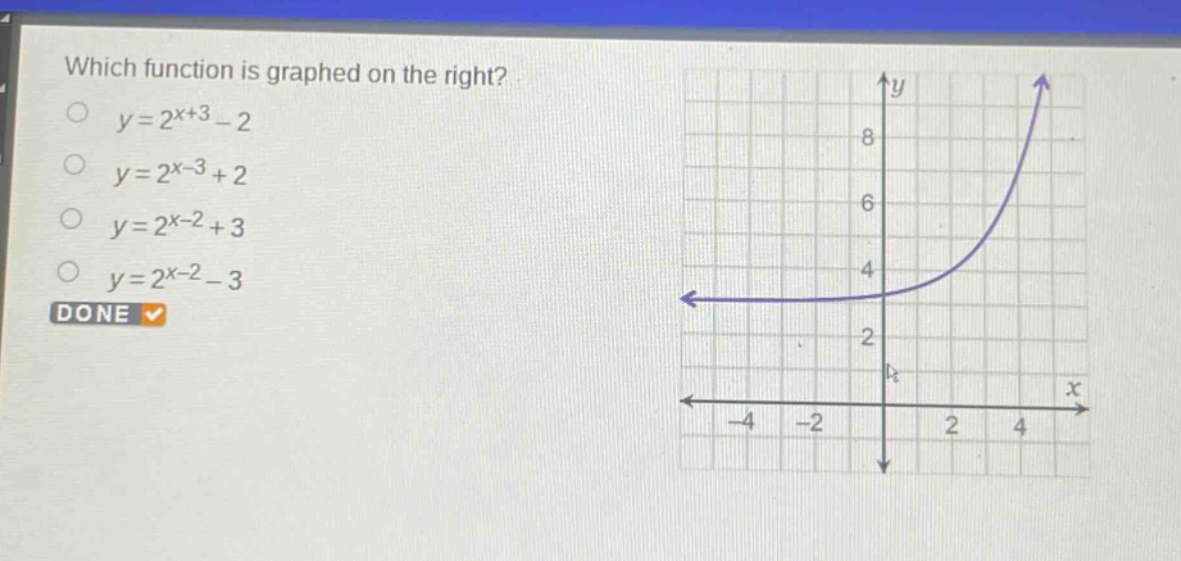
which function is graphed on the right?\n$y = 2^{x + 3}-2$\n$y = 2^{x - 3}+2$\n$y = 2^{x - 2}+3$\n$y = 2^{x - 2}-3$\ndone
Answer
Explanation:
Step1: Recall the general form of an exponential - function transformation
The general form of an exponential function is $y = a\cdot b^{x - h}+k$, where $(h,k)$ is the horizontal and vertical shift of the parent - function $y = b^{x}$. The parent - function of the given exponential functions is $y = 2^{x}$ which has a $y$ - intercept at $(0,1)$ and passes through the point $(1,2)$.
Step2: Check the $y$ - intercept
For the function $y = 2^{x+3}-2$, when $x = 0$, $y=2^{0 + 3}-2=8 - 2=6$. For the function $y = 2^{x - 3}+2$, when $x = 0$, $y=2^{0 - 3}+2=\frac{1}{8}+2=2\frac{1}{8}$. For the function $y = 2^{x - 2}+3$, when $x = 0$, $y=2^{0 - 2}+3=\frac{1}{4}+3=3\frac{1}{4}$. For the function $y = 2^{x - 2}-3$, when $x = 0$, $y=2^{0 - 2}-3=\frac{1}{4}-3=-2\frac{3}{4}$. From the graph, the $y$ - intercept is between $3$ and $4$. The function $y = 2^{x - 2}+3$ has a $y$ - intercept of $3\frac{1}{4}$.
Step3: Check the horizontal asymptote
The horizontal asymptote of an exponential function of the form $y=a\cdot b^{x - h}+k$ is $y = k$. The graph has a horizontal asymptote at $y = 3$. For the function $y = 2^{x - 2}+3$, the horizontal asymptote is $y = 3$.
Answer:
$y = 2^{x - 2}+3$