the function graphed to the right is of the form y = a sec bx + c or y = a csc bx + c for some a ≠ 0, b > 0…
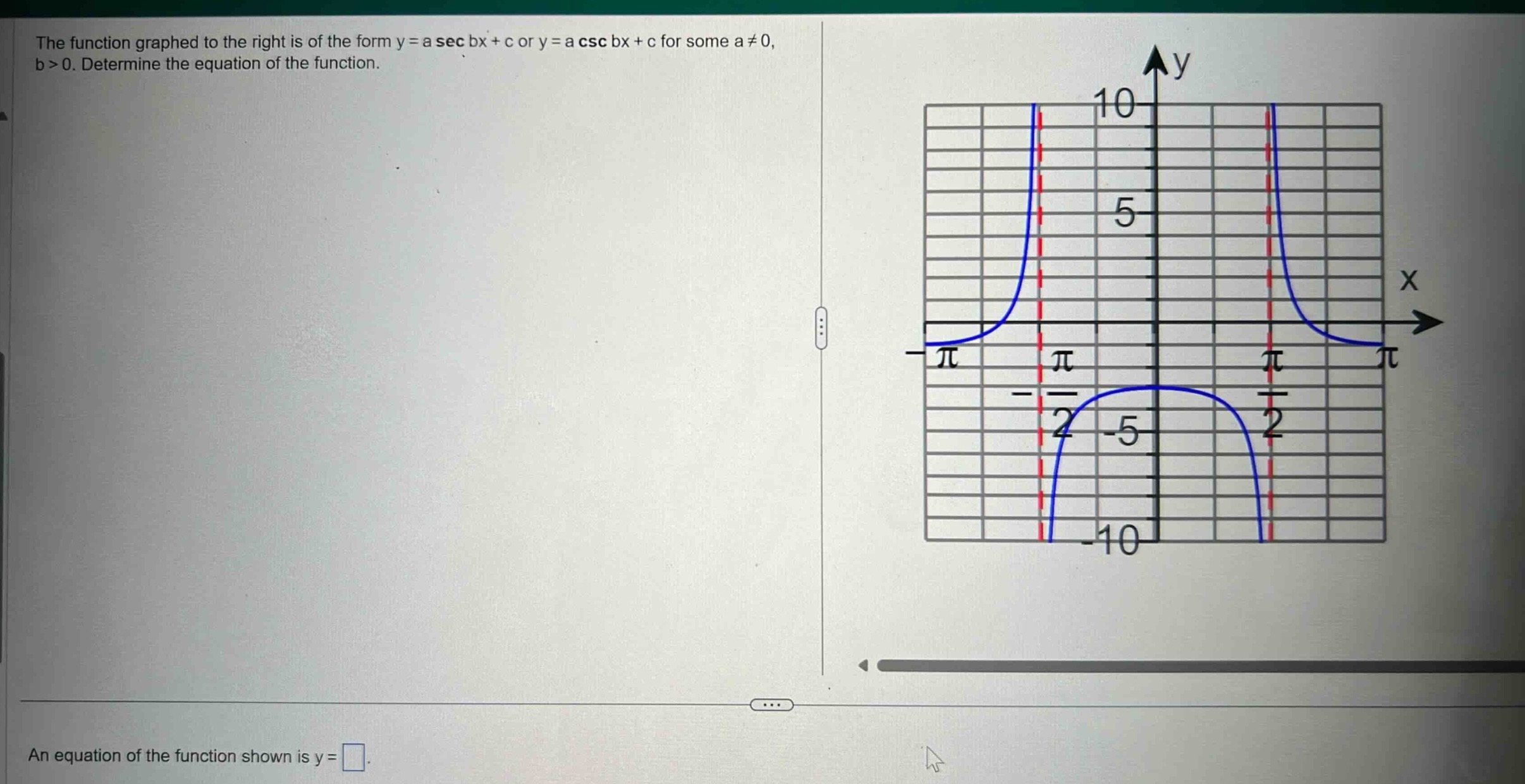
the function graphed to the right is of the form y = a sec bx + c or y = a csc bx + c for some a ≠ 0, b > 0. determine the equation of the function. an equation of the function shown is y =
Answer
Explanation:
Step1: Identify the type of function
The function has vertical asymptotes at (x =-\frac{\pi}{2}) and (x=\frac{\pi}{2}). The general form of a secant - type function is (y = a\sec(bx)+c) and for a cosecant - type function is (y=a\csc(bx)+c). The secant function (y = \sec x=\frac{1}{\cos x}) has vertical asymptotes where (\cos x = 0), and the cosecant function (y=\csc x=\frac{1}{\sin x}) has vertical asymptotes where (\sin x = 0). Since the vertical asymptotes are at (x=\pm\frac{\pi}{2}), the function is of the form (y = a\sec(bx)+c) (because (\cos x = 0) when (x=\pm\frac{\pi}{2}+k\pi,k\in\mathbb{Z})).
Step2: Find the value of (b)
The period (P) of the function (y = a\sec(bx)+c) is given by (P=\frac{2\pi}{b}). The distance between two consecutive vertical asymptotes is the period of the secant function. Here, the distance between (x =-\frac{\pi}{2}) and (x=\frac{\pi}{2}) is (\pi). So, (P=\pi). Using the period formula (\pi=\frac{2\pi}{b}), we can solve for (b). Cross - multiplying gives (b = 2).
Step3: Find the value of (c)
The mid - line of the function is (y=- 5). For the function (y=a\sec(bx)+c), the mid - line is (y = c). So, (c=-5).
Step4: Find the value of (a)
When (x = 0), (y=-5 + a). From the graph, when (x = 0), (y=-5 + 5=0). So, (a = 5).
Answer:
(y = 5\sec(2x)-5)