which function will have a y - intercept at -1 and an amplitude of 2?\n$f(x)=-sin(x)-1$\n$f(x)=-2sin(x)-1$\n$…
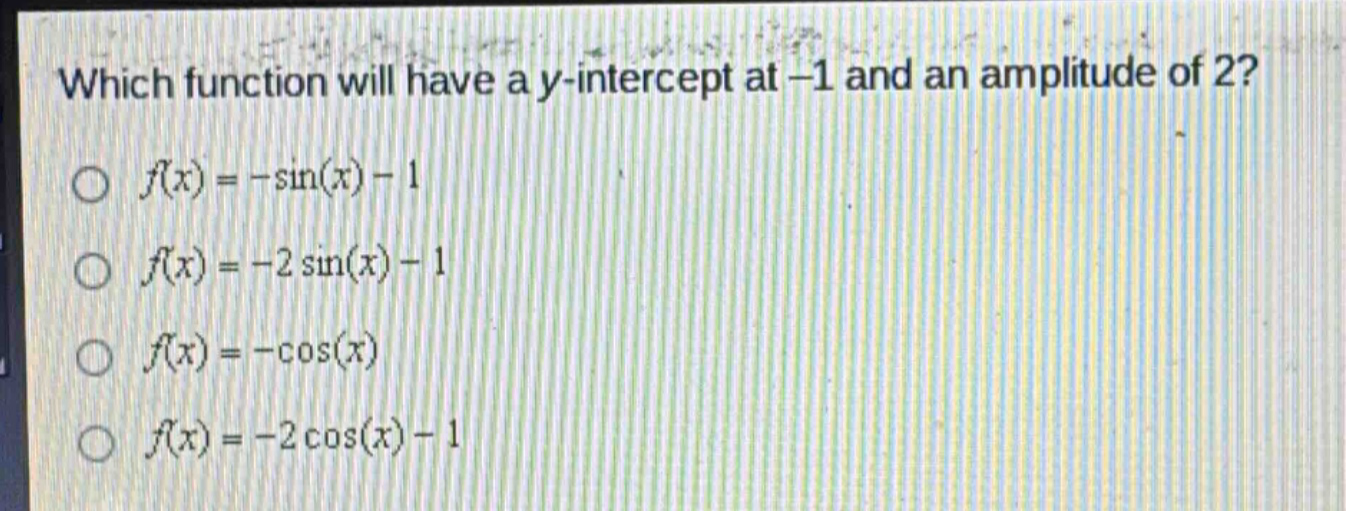
which function will have a y - intercept at -1 and an amplitude of 2?\n$f(x)=-sin(x)-1$\n$f(x)=-2sin(x)-1$\n$f(x)=-cos(x)$\n$f(x)=-2cos(x)-1$
Answer
Explanation:
Step1: Recall the formula for the y - intercept
The y - intercept of a function (y = f(x)) is found by setting (x = 0), i.e., (y=f(0)). Also, for a function of the form (y = A\sin(x)+k) or (y=A\cos(x)+k), the amplitude is (|A|).
Step2: Check the amplitude of each function
For (f(x)=-\sin(x)-1), the amplitude (|A| = | - 1|=1). For (f(x)=-2\sin(x)-1), the amplitude (|A|=|-2| = 2). For (f(x)=-\cos(x)), the amplitude (|A|=|-1| = 1). For (f(x)=-2\cos(x)-1), the amplitude (|A|=|-2| = 2).
Step3: Check the y - intercept of functions with amplitude 2
For (f(x)=-2\sin(x)-1), when (x = 0), (f(0)=-2\sin(0)-1=-2\times0 - 1=-1). For (f(x)=-2\cos(x)-1), when (x = 0), (f(0)=-2\cos(0)-1=-2\times1 - 1=-3).
Answer:
(f(x)=-2\sin(x)-1)