a function $g(x)$ has $x$-intercepts at $(\\frac{1}{2},0)$ and $(6,0)$. which could be $g(x)$?\n$g(x)=2(x +…
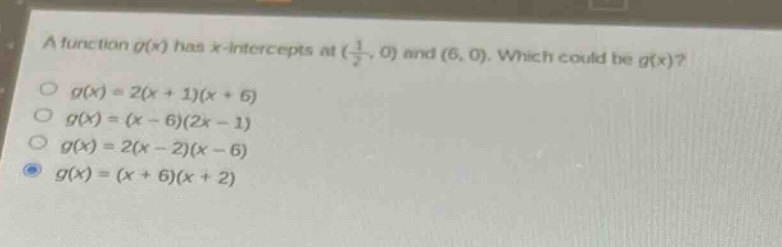
a function $g(x)$ has $x$-intercepts at $(\\frac{1}{2},0)$ and $(6,0)$. which could be $g(x)$?\n$g(x)=2(x + 1)(x + 6)$\n$g(x)=(x - 6)(2x - 1)$\n$g(x)=2(x - 2)(x - 6)$\n$g(x)=(x + 6)(x + 2)$
Answer
Explanation:
Step1: Recall x - intercept formula
If a function (y = g(x)) has an (x)-intercept at (x = a), then ((x - a)) is a factor of (g(x)).
Step2: Identify factors for given x - intercepts
The function (g(x)) has (x)-intercepts at (x=\frac{1}{2}) and (x = 6). So, ((x-\frac{1}{2})) and ((x - 6)) are factors of (g(x)). Multiply ((x-\frac{1}{2})) by 2 to get ((2x - 1)). So (g(x)=k(2x - 1)(x - 6)) where (k) is a non - zero constant. When (k = 1), (g(x)=(x - 6)(2x - 1)).
Answer:
(g(x)=(x - 6)(2x - 1)) (the second option)