a function and its inverse are shown on the graph. which statement describes the relationship between the…
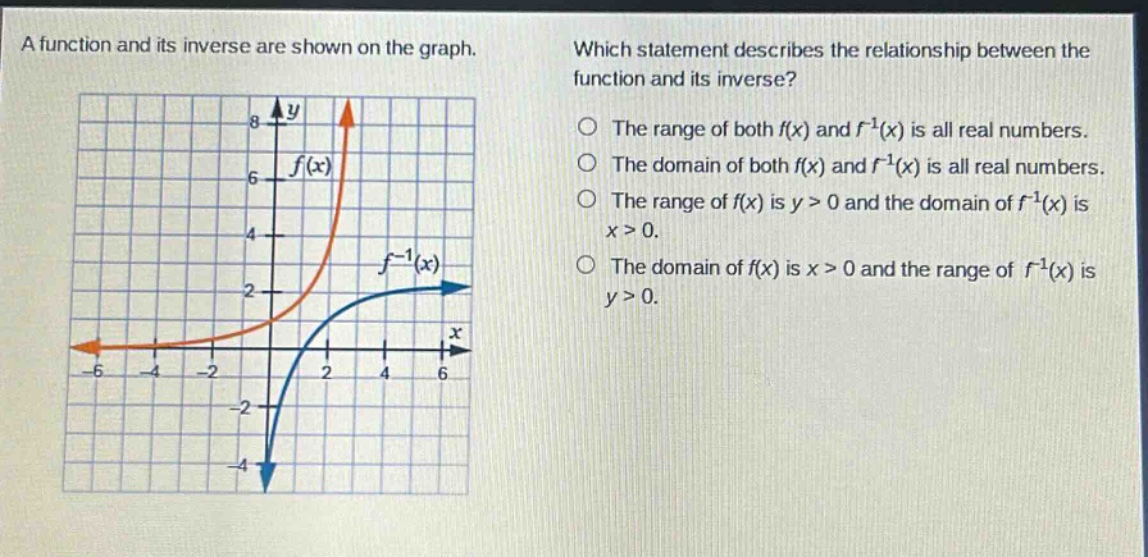
a function and its inverse are shown on the graph. which statement describes the relationship between the function and its inverse? the range of both f(x) and f⁻¹(x) is all real numbers. the domain of both f(x) and f⁻¹(x) is all real numbers. the range of f(x) is y > 0 and the domain of f⁻¹(x) is x > 0. the domain of f(x) is x > 0 and the range of f⁻¹(x) is y > 0.
Answer
Explanation:
Step1: Recall domain - range relationship of inverse functions
The domain of a function (f(x)) is the range of its inverse (f^{-1}(x)), and the range of (f(x)) is the domain of (f^{-1}(x)).
Step2: Analyze the graph
From the graph, we can see that the function (f(x)) has values only for (x>0) (its domain), and the inverse function (f^{-1}(x)) has values only for (y > 0) (its range).
Answer:
The domain of (f(x)) is (x>0) and the range of (f^{-1}(x)) is (y > 0).