which function has a range of y < 3?\no y = 3(2)^x\no y = 2(3)^x\no y = -(2)^x + 3\no y = (2)^x - 3
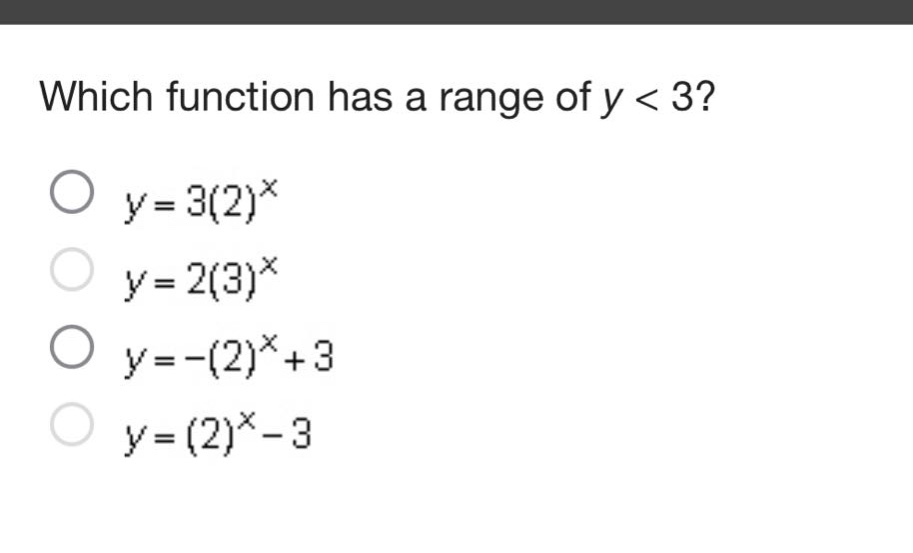
which function has a range of y < 3?\no y = 3(2)^x\no y = 2(3)^x\no y = -(2)^x + 3\no y = (2)^x - 3
Answer
Explanation:
Step1: Recall exponential - function properties
For an exponential function of the form $y = a\cdot b^{x}+k$, the range depends on the sign of $a$ and the value of $k$. The general form of an exponential function $y = b^{x}$ ($b>0,b\neq1$) has a range of $(0,+\infty)$ when $a > 0$ and $(-\infty,0)$ when $a<0$.
Step2: Analyze $y = 3(2)^{x}$
Since $a = 3>0$ and $b = 2>1$, the function $y = 3(2)^{x}$ has a range of $(0,+\infty)$ because as $x\to-\infty$, $y\to0$ and as $x\to+\infty$, $y\to+\infty$.
Step3: Analyze $y = 2(3)^{x}$
Since $a = 2>0$ and $b = 3>1$, the function $y = 2(3)^{x}$ has a range of $(0,+\infty)$ because as $x\to-\infty$, $y\to0$ and as $x\to+\infty$, $y\to+\infty$.
Step4: Analyze $y=-(2)^{x}+3$
For the function $y =-(2)^{x}+3$, we know that the function $y = 2^{x}$ has a range of $(0,+\infty)$. Then $y=-(2)^{x}$ has a range of $(-\infty,0)$ (multiplying by - 1 flips the range). Adding 3 to $y =-(2)^{x}$ shifts the range up by 3 units. So the range of $y=-(2)^{x}+3$ is $(-\infty,3)$.
Step5: Analyze $y=(2)^{x}-3$
Since the range of $y = 2^{x}$ is $(0,+\infty)$, subtracting 3 from it gives a range of $(-3,+\infty)$ (shifting the range down by 3 units).
Answer:
$y=-(2)^{x}+3$