which function has real zeros at x = 3 and x = 7?\n○ f(x)=x² + 4x - 21\n○ f(x)=x² - 4x - 21\n○ f(x)=x² - 10x…
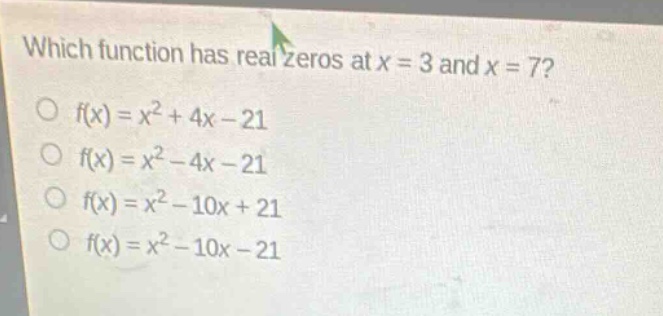
which function has real zeros at x = 3 and x = 7?\n○ f(x)=x² + 4x - 21\n○ f(x)=x² - 4x - 21\n○ f(x)=x² - 10x + 21\n○ f(x)=x² - 10x - 21
Answer
Explanation:
Step1: Recall zero - product property
If a function (f(x)) has zeros at (x = a) and (x = b), then (f(x)=(x - a)(x - b)). Here (a = 3) and (b=7), so (f(x)=(x - 3)(x - 7)).
Step2: Expand the product
Using the FOIL method ((x - 3)(x - 7)=x\times x+x\times(-7)+(-3)\times x+(-3)\times(-7)=x^{2}-7x-3x + 21=x^{2}-10x + 21).
Answer:
(f(x)=x^{2}-10x + 21) (the third option)