is the function represented by the table linear?\n| x | y |\n|----|----|\n| 10 | -6 |\n| 11 | 1 |\n| 12 | 6…
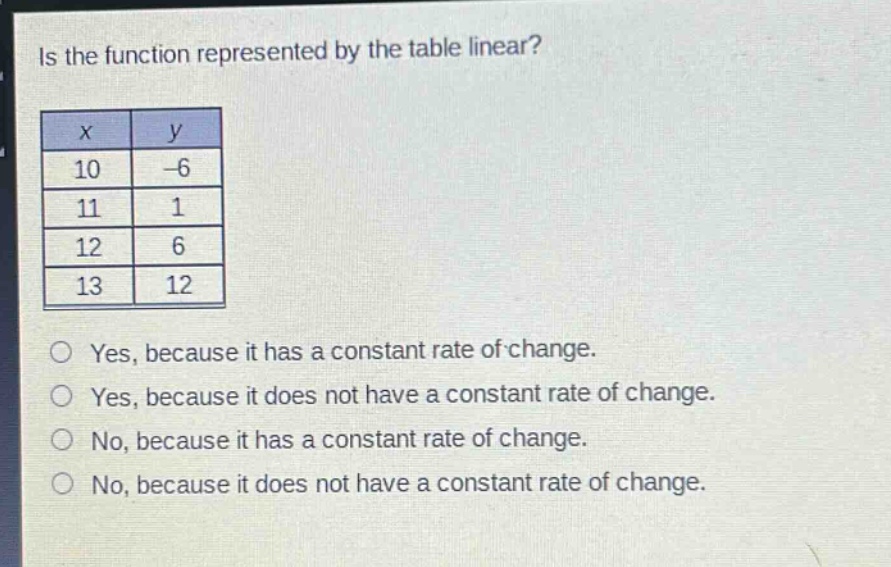
is the function represented by the table linear?\n| x | y |\n|----|----|\n| 10 | -6 |\n| 11 | 1 |\n| 12 | 6 |\n| 13 | 12 |\no yes, because it has a constant rate of change.\no yes, because it does not have a constant rate of change.\no no, because it has a constant rate of change.\no no, because it does not have a constant rate of change.
Answer
Explanation:
Step1: Calculate rate of change between first two points
The rate of change (slope) formula is $m=\frac{y_2 - y_1}{x_2 - x_1}$. For $(x_1,y_1)=(10,-6)$ and $(x_2,y_2)=(11,1)$, $m_1=\frac{1-(-6)}{11 - 10}=\frac{1 + 6}{1}=7$.
Step2: Calculate rate of change between second and third points
For $(x_1,y_1)=(11,1)$ and $(x_2,y_2)=(12,6)$, $m_2=\frac{6 - 1}{12 - 11}=\frac{5}{1}=5$.
Step3: Analyze constancy of rate of change
Since $m_1 = 7$ and $m_2=5$, the rate of change is not constant.
Answer:
No, because it does not have a constant rate of change.