which function represents exponential decay?\n○ $f(x)=\frac{1}{2}(\frac{3}{2})^x$\n○ $f(x)=\frac{1}{2}(-\frac…
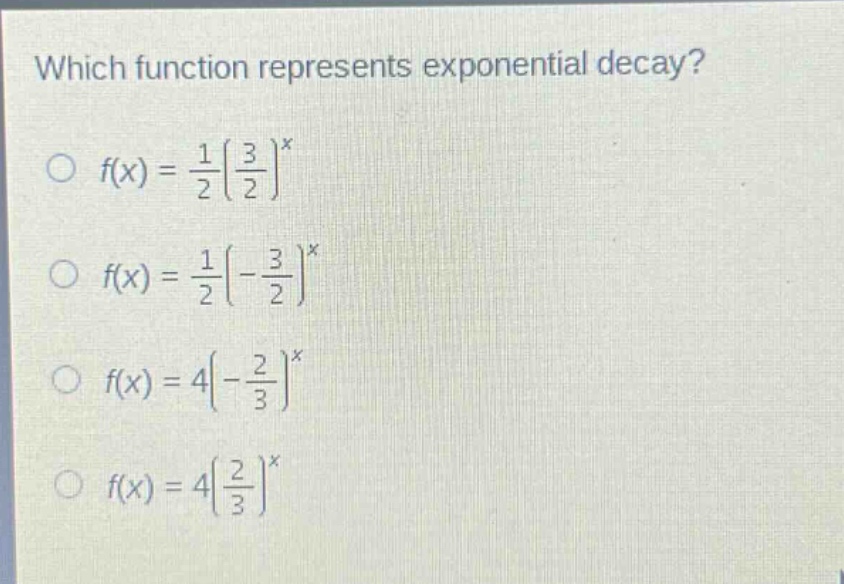
which function represents exponential decay?\n○ $f(x)=\frac{1}{2}(\frac{3}{2})^x$\n○ $f(x)=\frac{1}{2}(-\frac{3}{2})^x$\n○ $f(x)=4(-\frac{2}{3})^x$\n○ $f(x)=4(\frac{2}{3})^x$
Answer
Explanation:
Step1: Recall exponential - decay form
The general form of an exponential function is $f(x)=a\cdot b^{x}$, where $a\neq0$, $b > 0$, and for exponential decay, $0 < b<1$.
Step2: Analyze each option
- For $f(x)=\frac{1}{2}(\frac{3}{2})^{x}$, here $b = \frac{3}{2}>1$, so it represents exponential growth.
- For $f(x)=\frac{1}{2}(-\frac{3}{2})^{x}$, since $b=-\frac{3}{2}<0$, this is not a valid exponential - function (because the base of an exponential function $y = b^{x}$ should be $b>0$).
- For $f(x)=4(-\frac{2}{3})^{x}$, since $b =-\frac{2}{3}<0$, this is not a valid exponential - function.
- For $f(x)=4(\frac{2}{3})^{x}$, here $a = 4$ and $b=\frac{2}{3}$, and $0<\frac{2}{3}<1$, so it represents exponential decay.
Answer:
$f(x)=4(\frac{2}{3})^{x}$