which function rule models the function over the domain specified in the table below?\n| x | f(x) |\n| -7 |…
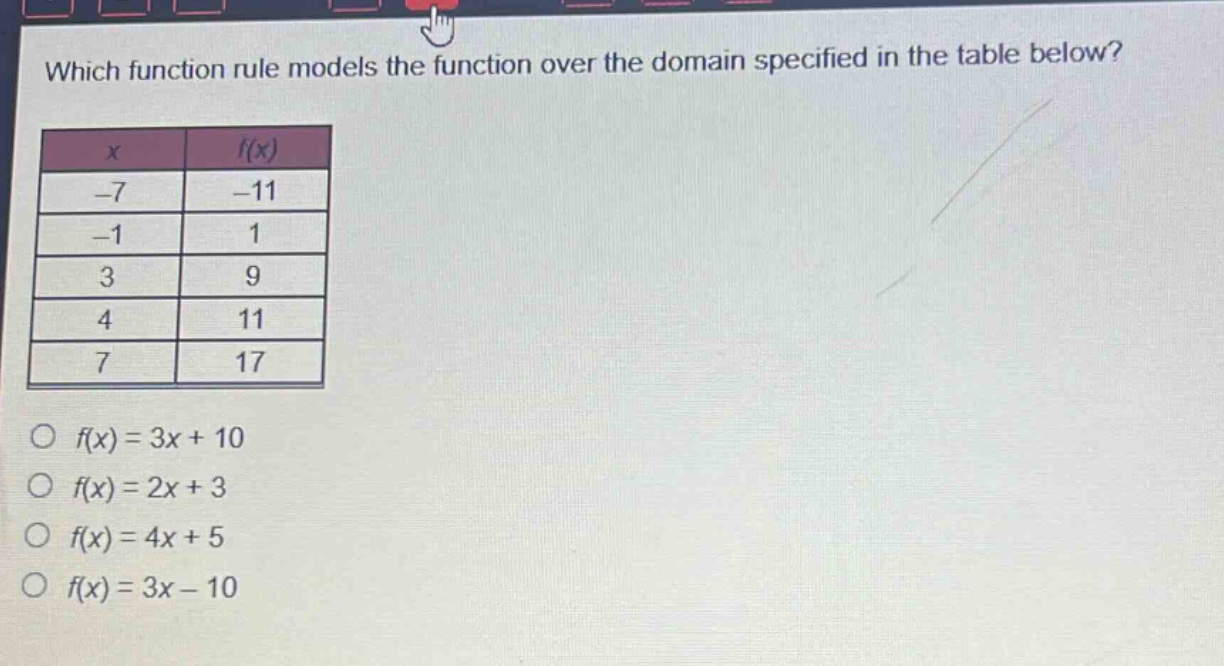
which function rule models the function over the domain specified in the table below?\n| x | f(x) |\n| -7 | -11 |\n| -1 | 1 |\n| 3 | 9 |\n| 4 | 11 |\n| 7 | 17 |\n○ f(x)=3x + 10\n○ f(x)=2x + 3\n○ f(x)=4x + 5\n○ f(x)=3x - 10
Answer
Explanation:
Step1: Test first - row values
Substitute (x=-7) into each function. For (f(x)=3x + 10), (f(-7)=3\times(-7)+10=-21 + 10=-11). For (f(x)=2x + 3), (f(-7)=2\times(-7)+3=-14 + 3=-11). For (f(x)=4x + 5), (f(-7)=4\times(-7)+5=-28+5=-23). For (f(x)=3x - 10), (f(-7)=3\times(-7)-10=-21-10=-31). So we can rule out (f(x)=4x + 5) and (f(x)=3x - 10).
Step2: Test second - row values
Substitute (x = - 1) into (f(x)=3x + 10) and (f(x)=2x + 3). For (f(x)=3x + 10), (f(-1)=3\times(-1)+10=-3 + 10 = 7). For (f(x)=2x + 3), (f(-1)=2\times(-1)+3=-2 + 3=1). So we can rule out (f(x)=3x + 10). We can further check the remaining points with (f(x)=2x + 3). When (x = 3), (f(3)=2\times3+3=6 + 3=9). When (x = 4), (f(4)=2\times4+3=8 + 3=11). When (x = 7), (f(7)=2\times7+3=14 + 3=17).
Answer:
(f(x)=2x + 3)