the function rule $t_{-4,6}(x,y)$ could be used to describe which translation?\n a parallelogram on a…
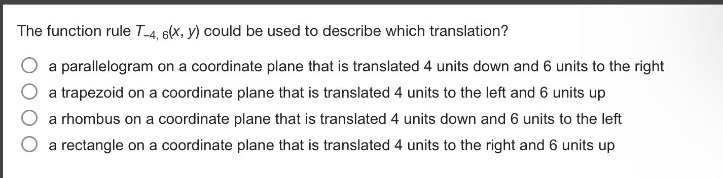
the function rule $t_{-4,6}(x,y)$ could be used to describe which translation?\n a parallelogram on a coordinate plane that is translated 4 units down and 6 units to the right\n a trapezoid on a coordinate plane that is translated 4 units to the left and 6 units up\n a rhombus on a coordinate plane that is translated 4 units down and 6 units to the left\n a rectangle on a coordinate plane that is translated 4 units to the right and 6 units up
Answer
Explanation:
Step1: Analyze the function rule
The function rule $T_{-4,6}(x,y)$ means a translation in the $x - y$ coordinate system. In a translation function $T_{a,b}(x,y)$, the value of $a$ affects the $x$-coordinate and $b$ affects the $y$-coordinate.
Step2: Determine the $x$-coordinate translation
For the $x$-coordinate, we have $a=-4$. A negative value of $a$ in $T_{a,b}(x,y)$ means a left - ward translation. So, the figure is translated $| - 4| = 4$ units to the left.
Step3: Determine the $y$-coordinate translation
For the $y$-coordinate, we have $b = 6$. A positive value of $b$ in $T_{a,b}(x,y)$ means an upward translation. So, the figure is translated 6 units up.
Answer:
a trapezoid on a coordinate plane that is translated 4 units to the left and 6 units up