the function f(x) = √(-x) is shown on the graph. which statement is correct? the domain of the function is…
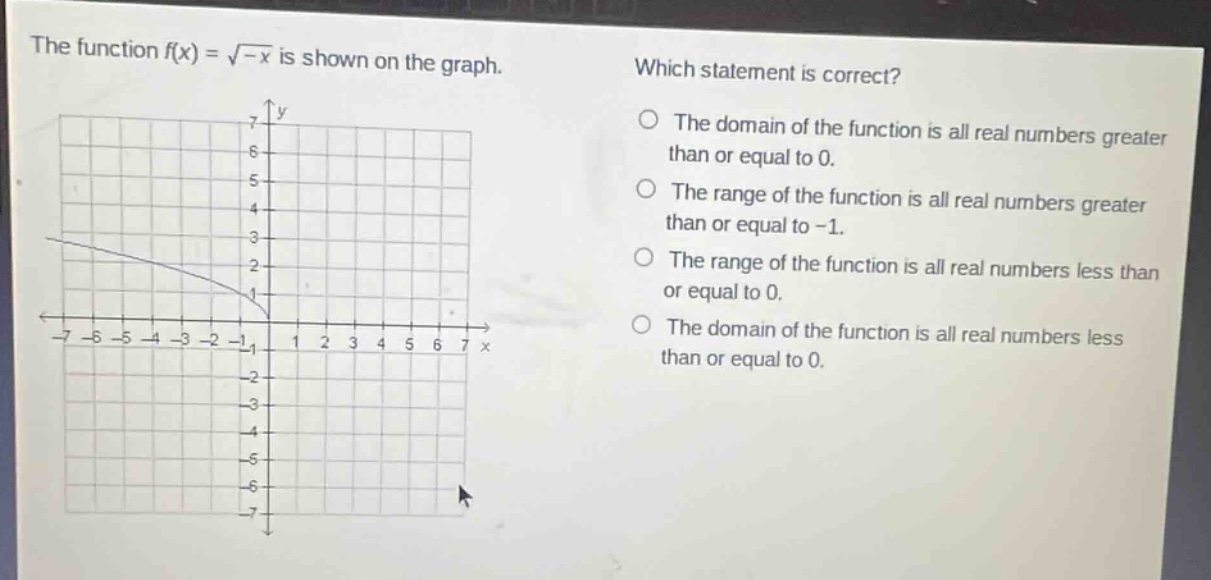
the function f(x) = √(-x) is shown on the graph. which statement is correct? the domain of the function is all real numbers greater than or equal to 0. the range of the function is all real numbers greater than or equal to -1. the range of the function is all real numbers less than or equal to 0. the domain of the function is all real numbers less than or equal to 0.
Answer
Explanation:
Step1: Determine the domain of the function.
The function is $f(x) = \sqrt{-x}$. For the square root to be defined for real numbers, the expression under the radical must be non-negative. $$-x \ge 0$$
Step2: Solve the inequality for the domain.
Multiply the inequality by -1 and reverse the inequality sign. $$x \le 0$$ So, the domain is all real numbers less than or equal to 0, which is $(-\infty, 0]$.
Step3: Determine the range of the function.
The principal square root function, $\sqrt{u}$, always returns a non-negative value, where $u \ge 0$. In this case, $u = -x$. $$f(x) = \sqrt{-x} \ge 0$$ So, the range is all real numbers greater than or equal to 0, which is $[0, \infty)$.
Step4: Evaluate the given statements.
Compare the calculated domain and range with the options provided. Option 1: Domain $x \ge 0$ (Incorrect). Option 2: Range $y \ge -1$ (Incorrect, the range is $y \ge 0$). Option 3: Range $y \le 0$ (Incorrect). Option 4: Domain $x \le 0$ (Correct).
Answer:
The domain of the function is all real numbers less than or equal to 0.