the function f(x) is shown below. is the inverse of f(x) also a function? use the drop - down menus to…
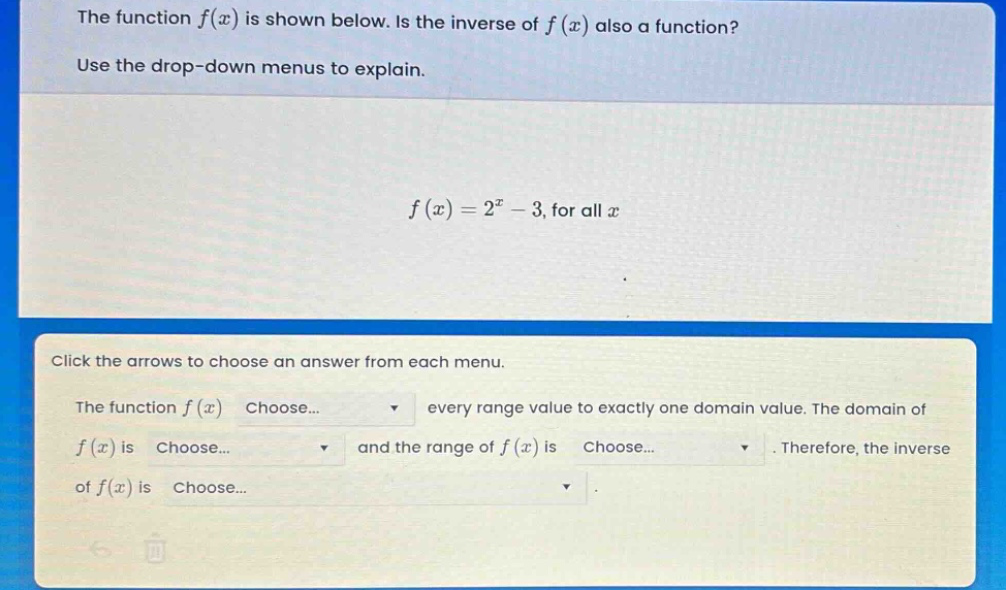
the function f(x) is shown below. is the inverse of f(x) also a function? use the drop - down menus to explain. f(x)=2^x - 3, for all x click the arrows to choose an answer from each menu. the function f(x) choose... every range value to exactly one domain value. the domain of f(x) is choose... and the range of f(x) is choose... therefore, the inverse of f(x) is choose...
Answer
Explanation:
Step1: Check one - to - one property
The exponential function $y = 2^{x}$ is one - to - one. The function $f(x)=2^{x}-3$ is a vertical shift of $y = 2^{x}$ down by 3 units. A one - to - one function maps every range value to exactly one domain value. So, $f(x)$ maps every range value to exactly one domain value.
Step2: Find domain and range
For the function $f(x)=2^{x}-3$, the domain of an exponential function of the form $y = a^{x}+b$ (where $a>0,a\neq1$) is all real numbers, i.e., $(-\infty,\infty)$. Since $2^{x}>0$ for all $x\in R$, then $2^{x}-3>- 3$. So the range of $f(x)$ is $(-3,\infty)$.
Step3: Determine inverse
A function has an inverse that is also a function if and only if the original function is one - to - one. Since $f(x)$ is one - to - one, its inverse is also a function.
Answer:
The function $f(x)$ maps every range value to exactly one domain value. The domain of $f(x)$ is $(-\infty,\infty)$ and the range of $f(x)$ is $(-3,\infty)$. Therefore, the inverse of $f(x)$ is a function.