the function $f(x)$ is shown in the table.\n| $x$ | -4 | -2 | 0 | 2 | 4 |\n| $f(x)$ | -18 | -12 | -6 | 0 | 6…
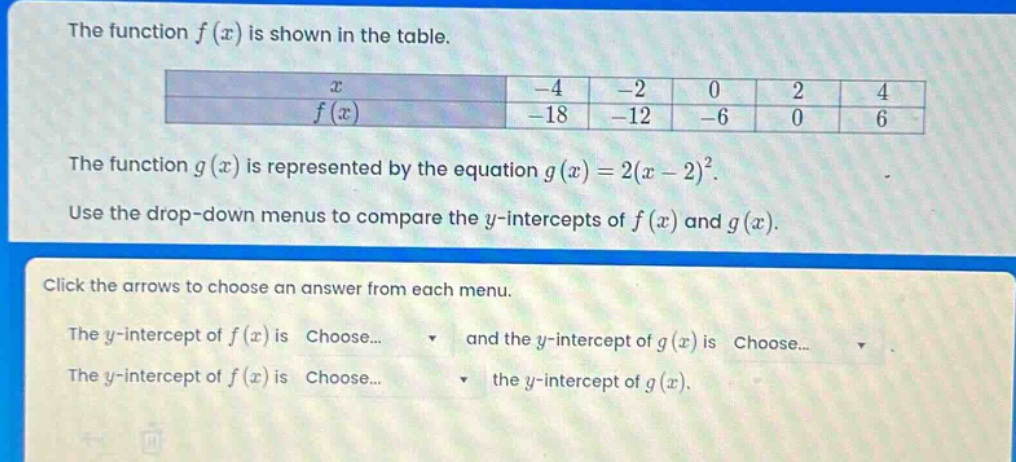
the function $f(x)$ is shown in the table.\n| $x$ | -4 | -2 | 0 | 2 | 4 |\n| $f(x)$ | -18 | -12 | -6 | 0 | 6 |\nthe function $g(x)$ is represented by the equation $g(x)=2(x - 2)^2$.\nuse the drop - down menus to compare the $y$-intercepts of $f(x)$ and $g(x)$.\nclick the arrows to choose an answer from each menu.\nthe $y$-intercept of $f(x)$ is choose... and the $y$-intercept of $g(x)$ is choose...\nthe $y$-intercept of $f(x)$ is choose... the $y$-intercept of $g(x)$.
Answer
Explanation:
Step1: Find y - intercept of f(x)
The y - intercept of a function is the value of the function when x = 0. From the table of f(x), when x = 0, f(0)=-6.
Step2: Find y - intercept of g(x)
To find the y - intercept of g(x)=2(x - 2)^2, substitute x = 0 into the function. g(0)=2(0 - 2)^2=2×(-2)^2=2×4 = 8.
Step3: Compare the y - intercepts
Since - 6<8, the y - intercept of f(x) is less than the y - intercept of g(x).
Answer:
The y - intercept of f(x) is - 6, and the y - intercept of g(x) is 8. The y - intercept of f(x) is less than the y - intercept of g(x).