which function has a simplified base of $4sqrt3{4}$?\n$f(x)=2(sqrt3{16})^x$\n$f(x)=2(sqrt3{64})^x$\n$f(x)=4(s…
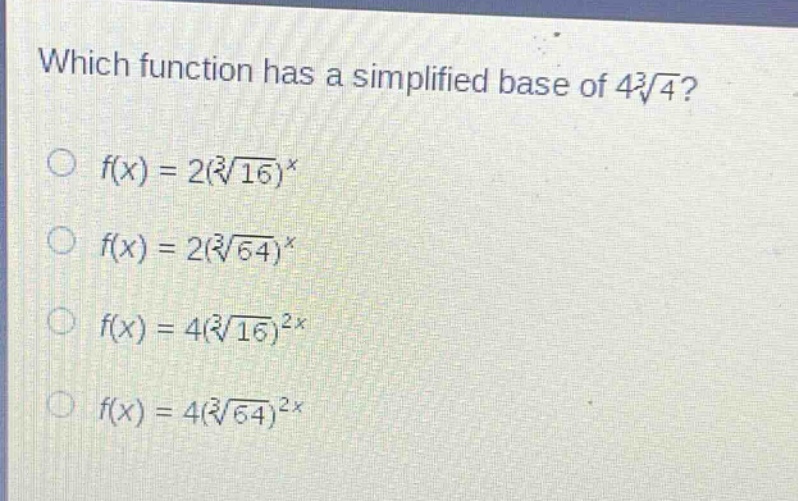
which function has a simplified base of $4sqrt3{4}$?\n$f(x)=2(sqrt3{16})^x$\n$f(x)=2(sqrt3{64})^x$\n$f(x)=4(sqrt3{16})^{2x}$\n$f(x)=4(sqrt3{64})^{2x}$
Answer
Explanation:
Step1: Recall the property of cube - root and exponent
We know that $\sqrt[3]{a}=a^{\frac{1}{3}}$.
Step2: Simplify the base $4\sqrt[3]{4}$
$4\sqrt[3]{4}=4\times4^{\frac{1}{3}}$. According to the rule $a^m\times a^n=a^{m + n}$, we have $4\times4^{\frac{1}{3}}=4^{1+\frac{1}{3}}=4^{\frac{4}{3}}$.
Step3: Simplify each option
Option 1: $f(x)=2(\sqrt[3]{16})^x$
$\sqrt[3]{16}=\sqrt[3]{2^4}=2^{\frac{4}{3}}$, so $f(x)=2\times(2^{\frac{4}{3}})^x=2^{1+\frac{4x}{3}}$, not the required form.
Option 2: $f(x)=2(\sqrt[3]{64})^x$
$\sqrt[3]{64}=4$, so $f(x)=2\times4^x$, not the required form.
Option 3: $f(x)=4(\sqrt[3]{16})^{2x}$
$\sqrt[3]{16}=\sqrt[3]{2^4}=2^{\frac{4}{3}}$, then $(\sqrt[3]{16})^{2x}=(2^{\frac{4}{3}})^{2x}=2^{\frac{8x}{3}}$, and $f(x)=4\times2^{\frac{8x}{3}}=2^2\times2^{\frac{8x}{3}}=2^{2 + \frac{8x}{3}}$, not the required form.
Option 4: $f(x)=4(\sqrt[3]{64})^{2x}$
$\sqrt[3]{64}=4$, so $(\sqrt[3]{64})^{2x}=4^{2x}$. Then $f(x)=4\times4^{2x}$. Using the rule $a^m\times a^n=a^{m + n}$, we get $f(x)=4^{1 + 2x}$. Also, $4\sqrt[3]{4}=4^{1+\frac{1}{3}}$, and if we consider the general form of an exponential function with base - related simplification, we can rewrite $4(\sqrt[3]{64})^{2x}$ as follows: $4(\sqrt[3]{64})^{2x}=4\times4^{2x}=4^{1 + 2x}$. And $4\sqrt[3]{4}=4\times4^{\frac{1}{3}}=4^{1+\frac{1}{3}}$. If we rewrite the function in terms of the base - exponent form, we know that $4\sqrt[3]{4}$ is the base we want.
Answer:
$f(x)=4(\sqrt[3]{64})^{2x}$