which function has a simplified base of $4\\sqrt3{4}$?\n$f(x)=2(\\sqrt3{16})^x$\n$f(x)=2(\\sqrt3{64})^x$\n$f(…
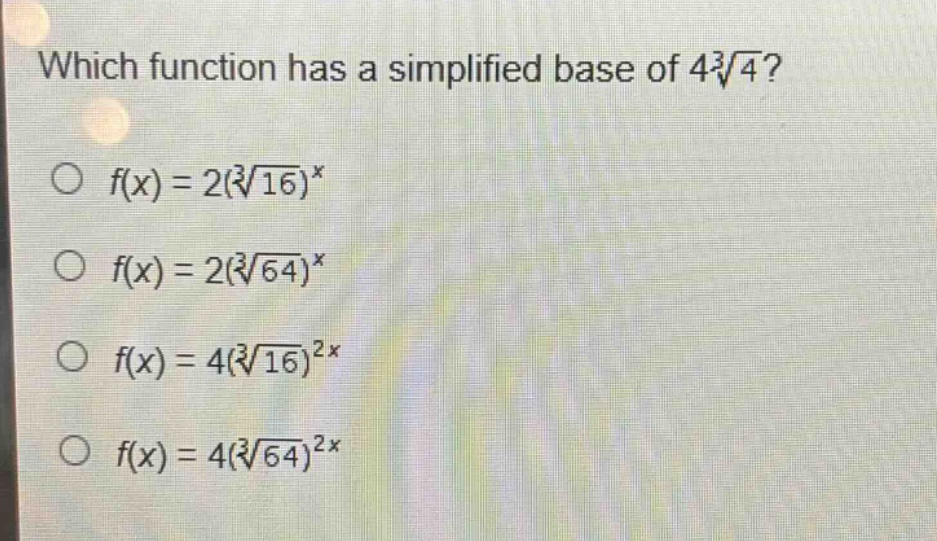
which function has a simplified base of $4\\sqrt3{4}$?\n$f(x)=2(\\sqrt3{16})^x$\n$f(x)=2(\\sqrt3{64})^x$\n$f(x)=4(\\sqrt3{16})^{2x}$\n$f(x)=4(\\sqrt3{64})^{2x}$
Answer
Explanation:
Step1: Simplify the target base
We know that (4\sqrt[3]{4}=4\times4^{\frac{1}{3}} = 4^{1 +\frac{1}{3}}=4^{\frac{4}{3}})
Step2: Simplify each option
Option 1: (f(x)=2(\sqrt[3]{16})^{x})
First, (16 = 2^{4}), so (\sqrt[3]{16}=2^{\frac{4}{3}}), then (f(x)=2\times(2^{\frac{4}{3}})^{x}=2^{1+\frac{4x}{3}}), not the target - base.
Option 2: (f(x)=2(\sqrt[3]{64})^{x})
Since (64 = 4^{3}), (\sqrt[3]{64}=4), then (f(x)=2\times4^{x}), not the target - base.
Option 3: (f(x)=4(\sqrt[3]{16})^{2x})
Since (16 = 4^{2}), (\sqrt[3]{16}=4^{\frac{2}{3}}), then (f(x)=4\times(4^{\frac{2}{3}})^{2x}=4\times4^{\frac{4x}{3}}=4^{1+\frac{4x}{3}}), and when considering the base (ignoring the exponent part), the base is (4^{\frac{4}{3}}) which is (4\sqrt[3]{4})
Option 4: (f(x)=4(\sqrt[3]{64})^{2x})
Since (\sqrt[3]{64}=4), then (f(x)=4\times4^{2x}=4^{1 + 2x}), not the target - base.
Answer:
(f(x)=4(\sqrt[3]{16})^{2x})