the function (f(x)=x^{2}) has been translated 9 units up and 4 units to the right to form the function…
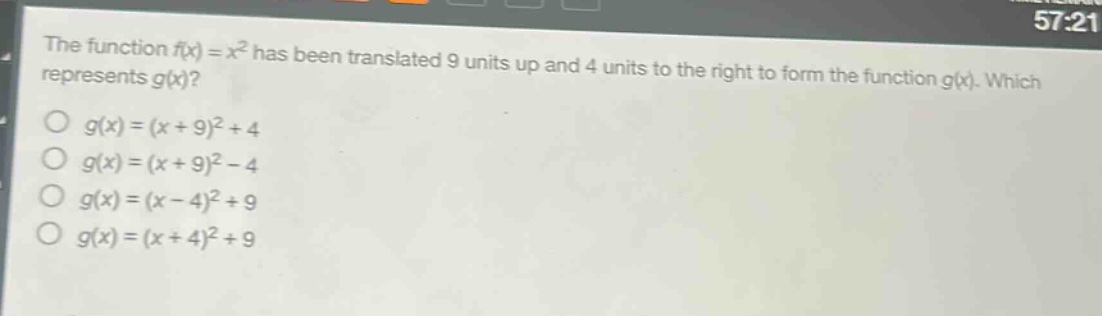
the function (f(x)=x^{2}) has been translated 9 units up and 4 units to the right to form the function (g(x)). which represents (g(x))?\n(g(x)=(x + 9)^{2}+4)\n(g(x)=(x + 9)^{2}-4)\n(g(x)=(x - 4)^{2}+9)\n(g(x)=(x + 4)^{2}+9)
Answer
Answer:
C. $g(x)=(x - 4)^2+9$
Explanation:
Step1: Recall horizontal - shift rule
For a function $y = f(x)$, a shift of $h$ units to the right gives $y=f(x - h)$. Here, $h = 4$, so $f(x)$ becomes $f(x - 4)=(x - 4)^2$.
Step2: Recall vertical - shift rule
For a function $y = f(x)$, a shift of $k$ units up gives $y=f(x)+k$. Here, $k = 9$, so $(x - 4)^2$ becomes $(x - 4)^2+9$.