the function $g(x)$ is a translation of $f(x)=(x + 3)^2-10$. the axis of symmetry of $g(x)$ is 5 units to…
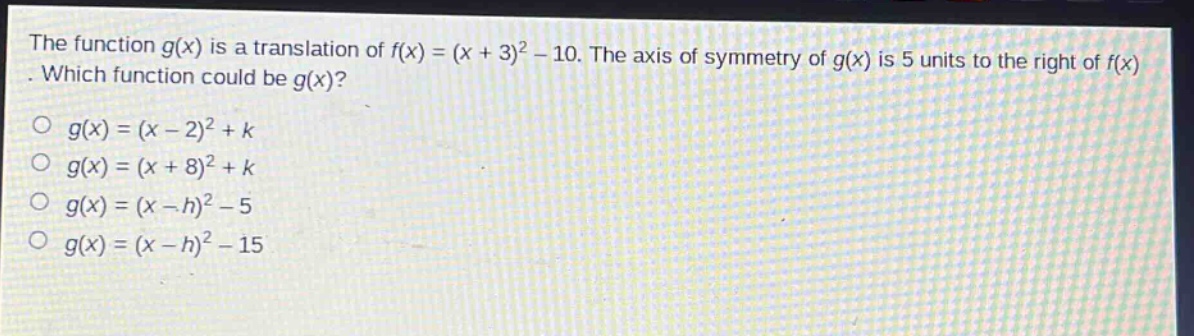
the function $g(x)$ is a translation of $f(x)=(x + 3)^2-10$. the axis of symmetry of $g(x)$ is 5 units to the right of $f(x)$. which function could be $g(x)$?\n$g(x)=(x - 2)^2 + k$\n$g(x)=(x + 8)^2 + k$\n$g(x)=(x - h)^2-5$\n$g(x)=(x - h)^2-15$
Answer
Explanation:
Step1: Find axis of symmetry of $f(x)$
For a quadratic function in vertex - form $y=a(x - h)^2 + k$, the axis of symmetry is $x = h$. For $f(x)=(x + 3)^2-10$, where $h=-3$, the axis of symmetry of $f(x)$ is $x=-3$.
Step2: Determine axis of symmetry of $g(x)$
The axis of symmetry of $g(x)$ is 5 units to the right of $f(x)$'s axis of symmetry. So, $x=-3 + 5=2$.
Step3: Identify the form of $g(x)$
For a quadratic function $g(x)=(x - m)^2 + n$, its axis of symmetry is $x = m$. Since the axis of symmetry of $g(x)$ is $x = 2$, the function $g(x)$ has the form $g(x)=(x - 2)^2 + k$.
Answer:
$g(x)=(x - 2)^2 + k$