which function has a vertex at (2, -9)?\n○ (f(x)=-(x - 3)^2)\n○ (f(x)=(x + 8)^2)\n○ (f(x)=(x - 5)(x + 1))\n○…
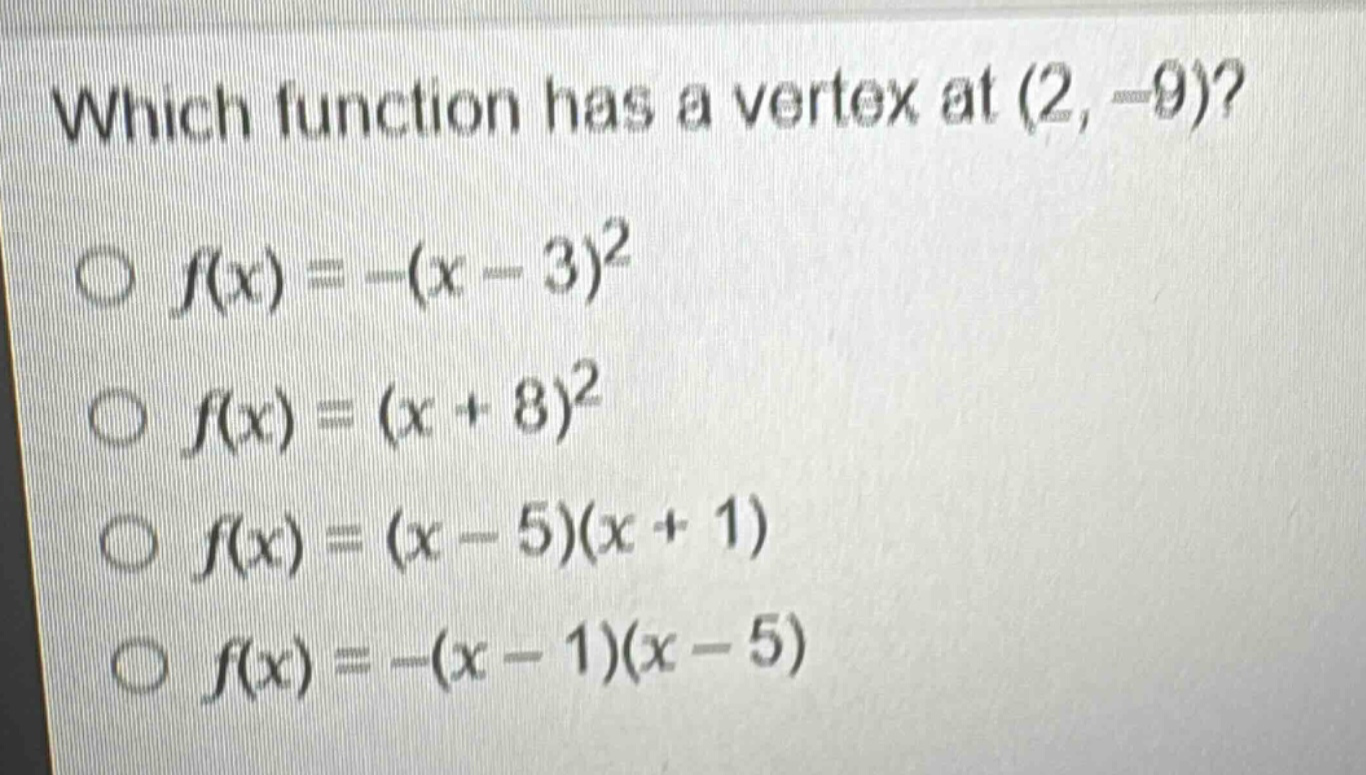
which function has a vertex at (2, -9)?\n○ (f(x)=-(x - 3)^2)\n○ (f(x)=(x + 8)^2)\n○ (f(x)=(x - 5)(x + 1))\n○ (f(x)=-(x - 1)(x - 5))
Answer
Explanation:
Step1: Recall vertex - form of a quadratic function
The vertex - form of a quadratic function is $y=a(x - h)^2+k$, where $(h,k)$ is the vertex of the parabola. We can also expand quadratic functions in factored form $y=a(x - x_1)(x - x_2)$ and convert them to vertex - form or use the formula $x=-\frac{b}{2a}$ for the $x$ - coordinate of the vertex of the quadratic function $y = ax^{2}+bx + c$.
Step2: Analyze option 1
For the function $f(x)=-(x - 3)^2$, the vertex is $(3,0)$ according to the vertex - form $y=a(x - h)^2+k$ (here $h = 3,k = 0$).
Step3: Analyze option 2
For the function $f(x)=(x + 8)^2$, the vertex is $(-8,0)$ according to the vertex - form $y=a(x - h)^2+k$ (here $h=-8,k = 0$).
Step4: Expand option 3
Expand $f(x)=(x - 5)(x + 1)=x^{2}+x-5x - 5=x^{2}-4x - 5$. The $x$ - coordinate of the vertex of a quadratic function $y=ax^{2}+bx + c$ is $x=-\frac{b}{2a}$. Here $a = 1,b=-4,c=-5$, so $x=-\frac{-4}{2\times1}=2$. Substitute $x = 2$ into $y=x^{2}-4x - 5$: $y=2^{2}-4\times2-5=4 - 8 - 5=-9$.
Step5: Expand option 4
Expand $f(x)=-(x - 1)(x - 5)=-(x^{2}-5x-x + 5)=-x^{2}+6x - 5$. The $x$ - coordinate of the vertex is $x=-\frac{b}{2a}=-\frac{6}{2\times(-1)} = 3$. Substitute $x = 3$ into $y=-x^{2}+6x - 5$: $y=-3^{2}+6\times3-5=-9 + 18-5=4$.
Answer:
C. $f(x)=(x - 5)(x + 1)$