which function in vertex form is equivalent to $f(x)=x^{2}+6x + 3$?\n$f(x)=(x + 3)^{2}+3$\n$f(x)=(x +…
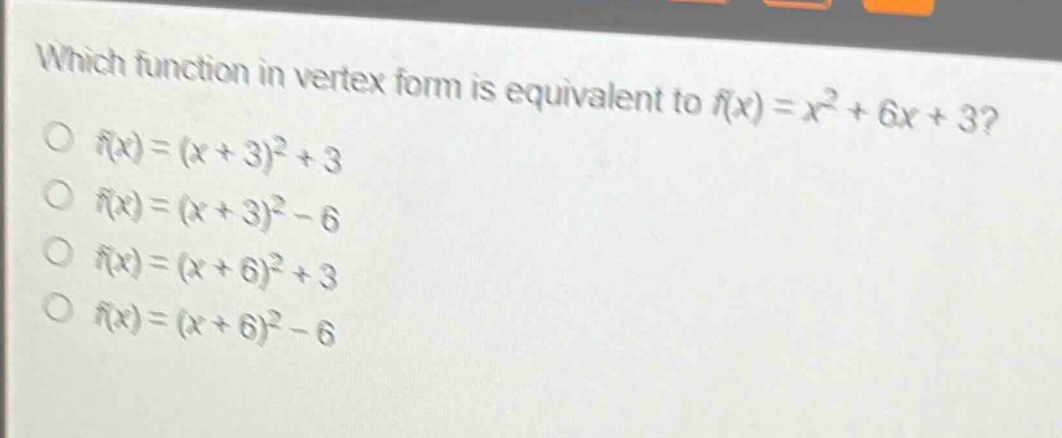
which function in vertex form is equivalent to $f(x)=x^{2}+6x + 3$?\n$f(x)=(x + 3)^{2}+3$\n$f(x)=(x + 3)^{2}-6$\n$f(x)=(x + 6)^{2}+3$\n$f(x)=(x + 6)^{2}-6$
Answer
Explanation:
Step1: Recall the vertex - form formula
The vertex - form of a quadratic function is (y=a(x - h)^2+k), and for the quadratic function (y = ax^{2}+bx + c), we can complete the square. Given (f(x)=x^{2}+6x + 3), where (a = 1), (b = 6), (c = 3).
Step2: Complete the square for the (x) - terms
For the expression (x^{2}+6x), we know that ((x + m)^{2}=x^{2}+2mx+m^{2}). If (2m = 6), then (m = 3) and ((x + 3)^{2}=x^{2}+6x + 9). So (x^{2}+6x=(x + 3)^{2}-9).
Step3: Rewrite the function in vertex - form
Substitute (x^{2}+6x=(x + 3)^{2}-9) into (f(x)=x^{2}+6x + 3). We get (f(x)=(x + 3)^{2}-9 + 3).
Step4: Simplify the expression
(f(x)=(x + 3)^{2}-6).
Answer:
B. (f(x)=(x + 3)^{2}-6)