which function has zeros at x = 10 and x = 2?\n○ f(x)=x² - 12x + 20\n○ f(x)=x² - 20x + 12\n○ f(x)=5x² + 40x…
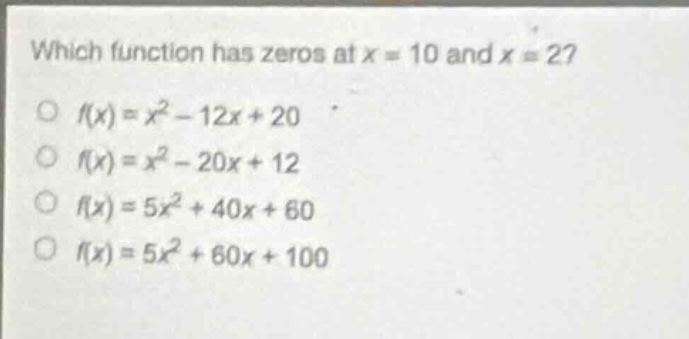
which function has zeros at x = 10 and x = 2?\n○ f(x)=x² - 12x + 20\n○ f(x)=x² - 20x + 12\n○ f(x)=5x² + 40x + 60\n○ f(x)=5x² + 60x + 100
Answer
Explanation:
Step1: Recall zero - product property
If a function has zeros at (x = a) and (x = b), then the function can be written in factored form as (f(x)=k(x - a)(x - b)), where (k) is a non - zero constant. Here (a = 10) and (b = 2), so (f(x)=k(x - 10)(x - 2)=k(x^{2}-2x-10x + 20)=k(x^{2}-12x + 20)). When (k = 1), (f(x)=x^{2}-12x + 20).
Step2: Check other functions
For (f(x)=x^{2}-20x + 12), using the quadratic formula (x=\frac{-b\pm\sqrt{b^{2}-4ac}}{2a}) with (a = 1), (b=-20), (c = 12), (x=\frac{20\pm\sqrt{400 - 48}}{2}=\frac{20\pm\sqrt{352}}{2}=10\pm2\sqrt{22}\neq10,2). For (f(x)=5x^{2}+40x + 60), first factor out 5: (f(x)=5(x^{2}+8x + 12)), then factor the quadratic inside the parentheses: (f(x)=5(x + 2)(x+6)), zeros are (x=-2) and (x=-6). For (f(x)=5x^{2}+60x + 100), factor out 5: (f(x)=5(x^{2}+12x + 20)=5(x + 2)(x + 10)), zeros are (x=-2) and (x=-10).
Answer:
(f(x)=x^{2}-12x + 20)