for all functions of the form f(x) = ax² + bx + c, which is true when b = 0?\nthe graph will always have…
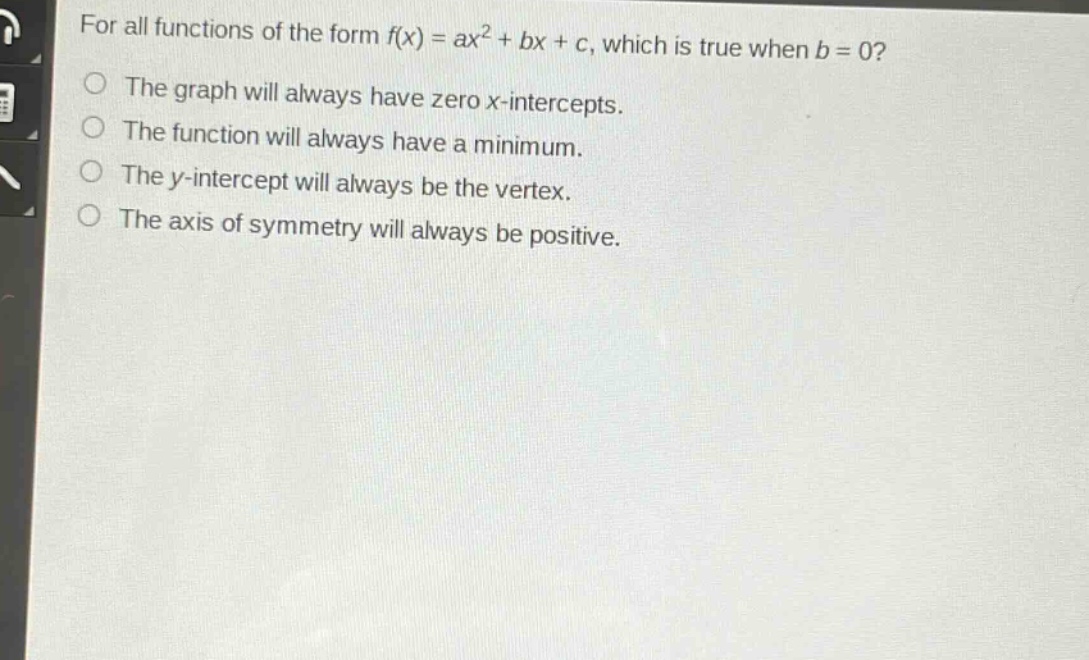
for all functions of the form f(x) = ax² + bx + c, which is true when b = 0?\nthe graph will always have zero x - intercepts.\nthe function will always have a minimum.\nthe y - intercept will always be the vertex.\nthe axis of symmetry will always be positive.
Answer
Explanation:
Step1: Recall the properties of quadratic functions
The general - form of a quadratic function is (y = ax^{2}+bx + c). The axis of symmetry is given by the formula (x=-\frac{b}{2a}), the (y) - intercept is the value of the function when (x = 0), i.e., (y(0)=c), and the vertex of the parabola has (x) - coordinate (x =-\frac{b}{2a}).
Step2: Analyze when (b = 0)
When (b = 0), the axis of symmetry formula (x=-\frac{b}{2a}) becomes (x = 0). The (y) - intercept of the function (y=ax^{2}+bx + c) is found by setting (x = 0), so (y(0)=c). The (x) - coordinate of the vertex is (x=-\frac{b}{2a}), and when (b = 0), (x = 0). So the (y) - intercept (the point ((0,c))) is the vertex of the parabola.
- For the (x) - intercepts, we set (y=ax^{2}+c = 0), then (ax^{2}=-c), (x^{2}=-\frac{c}{a}). If (a) and (c) have the same sign, there are no real (x) - intercepts.
- The function (y = ax^{2}+c) has a minimum when (a>0) and a maximum when (a < 0).
- The axis of symmetry (x = 0) is not positive.
Answer:
The (y) - intercept will always be the vertex.