in general, how does the growth of y = 4^x compare to the growth of y = 4x?\nthe function y = 4^x is growing…
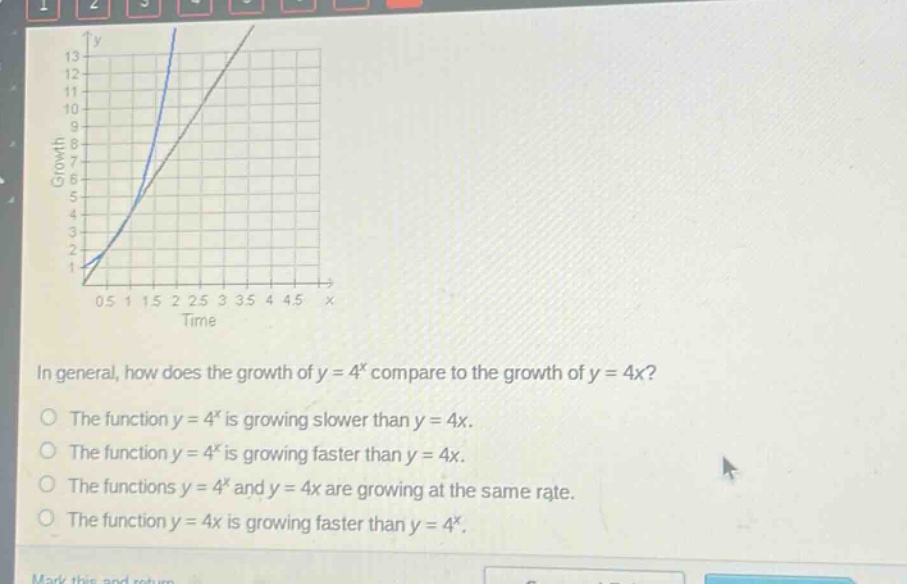
in general, how does the growth of y = 4^x compare to the growth of y = 4x?\nthe function y = 4^x is growing slower than y = 4x.\nthe function y = 4^x is growing faster than y = 4x.\nthe functions y = 4^x and y = 4x are growing at the same rate.\nthe function y = 4x is growing faster than y = 4^x.
Answer
Explanation:
Step1: Analyze function types
$y = 4x$ is a linear function with a constant - slope of 4. Its rate of change is constant.
Step2: Analyze exponential function
$y = 4^{x}$ is an exponential function. The derivative of $y = 4^{x}$ is $y^\prime=4^{x}\ln(4)$ using the formula $\frac{d}{dx}(a^{x})=a^{x}\ln(a)$. As $x$ increases, the value of $4^{x}\ln(4)$ increases.
Step3: Compare growth rates
For small values of $x$, the linear function $y = 4x$ may be larger. But as $x$ gets larger, the exponential function $y = 4^{x}$ will grow much faster than the linear function $y = 4x$.
Answer:
The function $y = 4^{x}$ is growing faster than $y = 4x$.