which geometric model using algebra tiles represents the factorization of $x^{2}-5x + 6$?
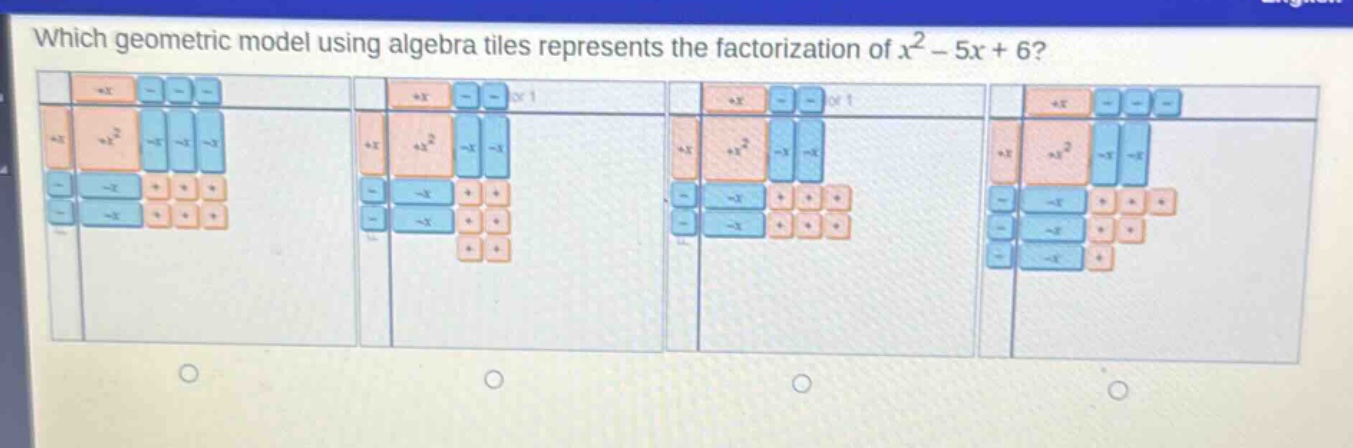
which geometric model using algebra tiles represents the factorization of $x^{2}-5x + 6$?
Answer
Answer:
First, factor the quadratic expression (x^{2}-5x + 6). We need to find two numbers that multiply to (6) and add up to (- 5). The numbers are (-2) and (-3) since ((-2)\times(-3)=6) and (-2+( - 3)=-5). So, (x^{2}-5x + 6=(x - 2)(x - 3)).
When using algebra - tiles to represent ((x - 2)(x - 3)):
- The (x^{2}) - tile is represented by a large square.
- The (-5x) is represented by (5) long - rectangular tiles (negative (x) - tiles).
- The (+6) is represented by (6) small square tiles (positive unit tiles).
We can build a rectangle with sides ((x - 2)) and ((x - 3)). The rectangle will have one (x^{2}) - tile, (3) negative (x) - tiles along one side and (2) negative (x) - tiles along the other side (for a total of (5) negative (x) - tiles), and (6) positive unit tiles in the corner.
We would need to visually inspect the given options to pick the one that has one large square ((x^{2})), five long - rectangles with the negative sign (for (-5x)) and six small positive squares (for (+6)).
Explanation:
Step1: Factor the quadratic
Find two numbers for factoring. We know that for (ax^{2}+bx + c) ((a = 1), (b=-5), (c = 6)), we find (m) and (n) such that (m\times n=ac = 6) and (m + n=b=-5). The numbers are (m=-2) and (n=-3), so (x^{2}-5x + 6=(x - 2)(x - 3)).
Step2: Interpret for algebra - tiles
Understand tile representation. The (x^{2}) term is one large square tile, the (-5x) terms are (5) negative (x) - rectangular tiles, and the (+6) term is (6) positive unit - square tiles. The factored form ((x - 2)(x - 3)) can be represented as a rectangle with side - lengths corresponding to the factors, which will have the correct combination of tiles.