ginny is studying a population of frogs. she determines that the population is decreasing at an average rate…
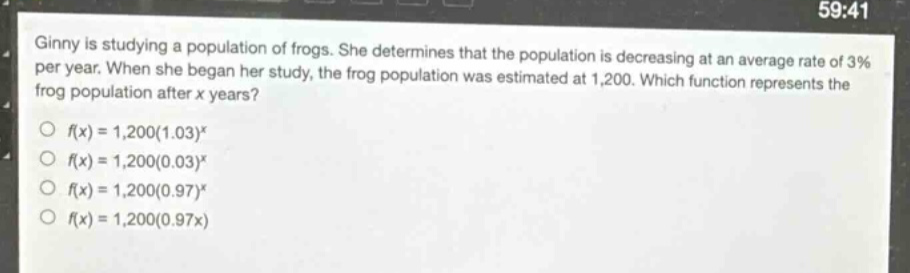
ginny is studying a population of frogs. she determines that the population is decreasing at an average rate of 3% per year. when she began her study, the frog population was estimated at 1,200. which function represents the frog population after x years?\n○ f(x)=1,200(1.03)^x\n○ f(x)=1,200(0.03)^x\n○ f(x)=1,200(0.97)^x\n○ f(x)=1,200(0.97x)
Answer
Explanation:
Step1: Recall the population - decay formula
The general formula for exponential decay is $f(x)=a(1 - r)^x$, where $a$ is the initial amount, $r$ is the rate of decay as a decimal, and $x$ is the number of time - periods.
Step2: Identify the values of $a$ and $r$
Given that $a = 1200$ (the initial frog population) and $r=0.03$ (since the population is decreasing at a rate of 3% or 3/100 = 0.03).
Step3: Substitute the values into the formula
Substitute $a = 1200$ and $r = 0.03$ into the formula $f(x)=a(1 - r)^x$. We get $f(x)=1200(1 - 0.03)^x=1200(0.97)^x$.
Answer:
$f(x)=1200(0.97)^x$