given:\np: x - 5 = 10\nq: 4x + 1 = 61\nwhich is the inverse of p → q?\nif x - 5 ≠ 10, then 4x + 1 ≠ 61.\nif…
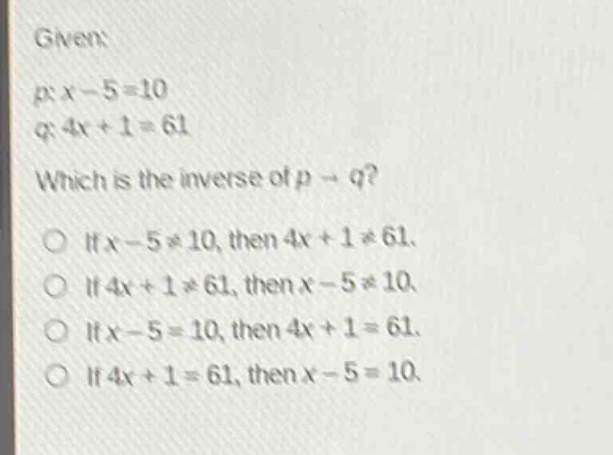
given:\np: x - 5 = 10\nq: 4x + 1 = 61\nwhich is the inverse of p → q?\nif x - 5 ≠ 10, then 4x + 1 ≠ 61.\nif 4x + 1 ≠ 61, then x - 5 ≠ 10.\nif x - 5 = 10, then 4x + 1 = 61.\nif 4x + 1 = 61, then x - 5 = 10.
Answer
Answer:
If (x - 5\neq10), then (4x + 1\neq61).
Explanation:
Step1: Definir la implicación
La implicación (p\rightarrow q) se lee "si (p) entonces (q)", donde (p:x - 5 = 10) y (q:4x+1 = 61).
Step2: Encontrar la inversa
La inversa de (p\rightarrow q) es (\neg p\rightarrow\neg q). Aquí, (\neg p) es (x - 5\neq10) y (\neg q) es (4x + 1\neq61). Entonces la inversa es "si (x - 5\neq10), entonces (4x + 1\neq61)".