given (f(x)=3x - 1) and (g(x)=2x - 3), for which value of (x) does (g(x)=f(2))?\n(x = \frac{3}{2})\n(x =…
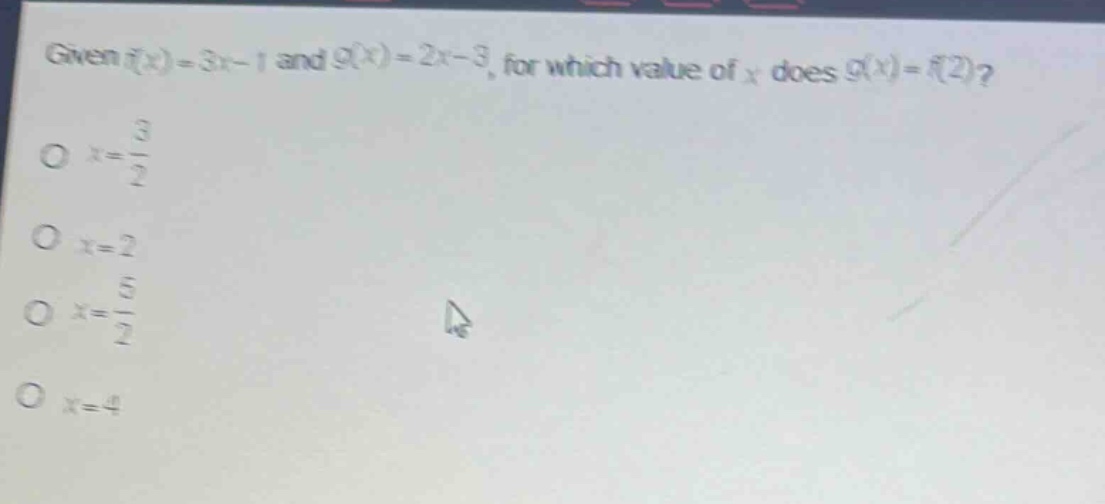
given (f(x)=3x - 1) and (g(x)=2x - 3), for which value of (x) does (g(x)=f(2))?\n(x = \frac{3}{2})\n(x = 2)\n(x=\frac{5}{2})\n(x = 4)
Answer
Explanation:
Step1: Calculate f(2)
Substitute x = 2 into f(x)=3x - 1. $f(2)=3\times2 - 1=6 - 1=5$
Step2: Set g(x) equal to f(2)
Set g(x)=2x - 3 equal to 5, so we have the equation 2x - 3 = 5.
Step3: Solve the equation for x
Add 3 to both sides of the equation: 2x=5 + 3=8. Then divide both sides by 2, $x=\frac{8}{2}=4$.
Answer:
x = 4