given $\begin{bmatrix}5& - 4\\3&6end{bmatrix}\begin{bmatrix}x\\yend{bmatrix}=\begin{bmatrix}12\\66end{bmatrix…
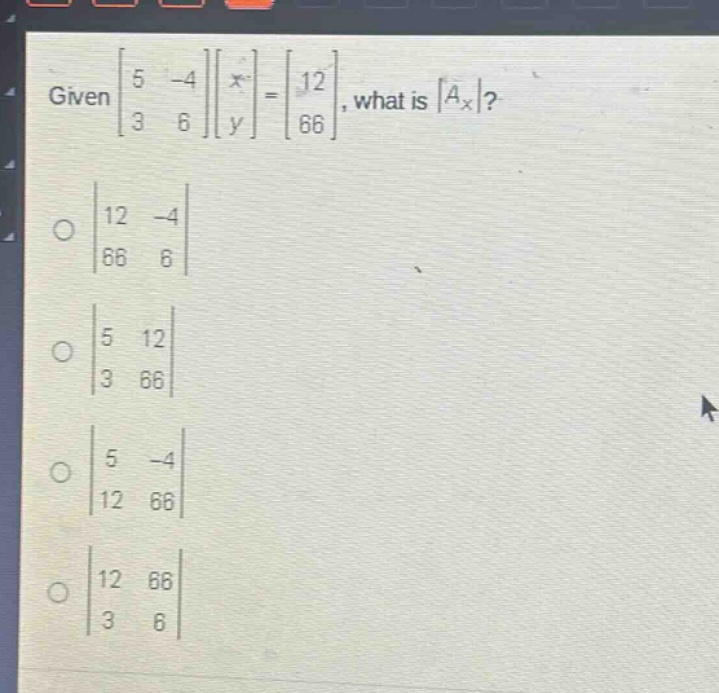
given $\begin{bmatrix}5& - 4\\3&6end{bmatrix}\begin{bmatrix}x\\yend{bmatrix}=\begin{bmatrix}12\\66end{bmatrix}$, what is $|a_x|$?\n$\begin{vmatrix}12& - 4\\66&6end{vmatrix}$\n$\begin{vmatrix}5&12\\3&66end{vmatrix}$\n$\begin{vmatrix}5& - 4\\12&66end{vmatrix}$\n$\begin{vmatrix}12&66\\3&6end{vmatrix}$
Answer
Explanation:
Step1: Recall Cramer's Rule
In a system of linear - equations (A\mathbf{x}=\mathbf{b}), where (A = \begin{bmatrix}a_{11}&a_{12}\a_{21}&a_{22}\end{bmatrix}), (\mathbf{x}=\begin{bmatrix}x\y\end{bmatrix}), and (\mathbf{b}=\begin{bmatrix}b_{1}\b_{2}\end{bmatrix}), the determinant (|A_x|) is obtained by replacing the first column of (A) with the column - vector (\mathbf{b}). Given (A=\begin{bmatrix}5& - 4\3&6\end{bmatrix}) and (\mathbf{b}=\begin{bmatrix}12\66\end{bmatrix}).
Step2: Form (A_x)
To find (|A_x|), we replace the first column of (A) with the elements of (\mathbf{b}). So (A_x=\begin{bmatrix}12& - 4\66&6\end{bmatrix}).
Answer:
A. (\begin{vmatrix}12& - 4\66&6\end{vmatrix})