given: $f(x)=\frac{1}{x + 5}$ and $g(x)=x - 2$. what are the restrictions of the domain of…
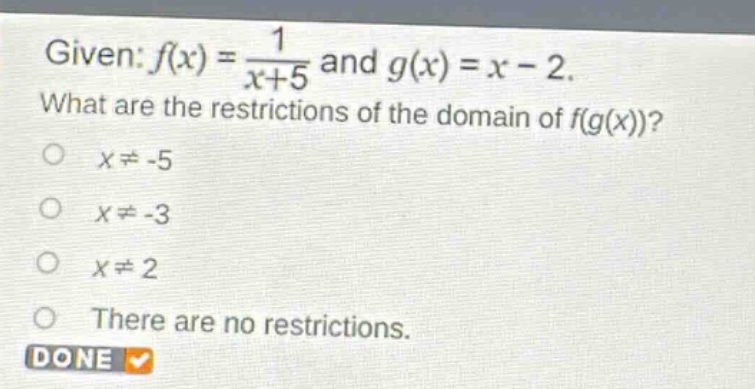
given: $f(x)=\frac{1}{x + 5}$ and $g(x)=x - 2$. what are the restrictions of the domain of $f(g(x))$?\n$x\neq - 5$\n$x\neq - 3$\n$x\neq 2$\nthere are no restrictions.
Answer
Explanation:
Step1: Find the composition $f(g(x))$
First, substitute $g(x)$ into $f(x)$. Since $f(x)=\frac{1}{x + 5}$ and $g(x)=x - 2$, then $f(g(x))=\frac{1}{(x - 2)+5}=\frac{1}{x+3}$.
Step2: Determine the domain - restriction
The denominator of a fraction cannot be zero. Set $x + 3\neq0$. Solving for $x$, we get $x\neq - 3$.
Answer:
$x\neq - 3$