given the information marked on the figures below, classify each quadrilateral as a \parallelogram\ or \not…
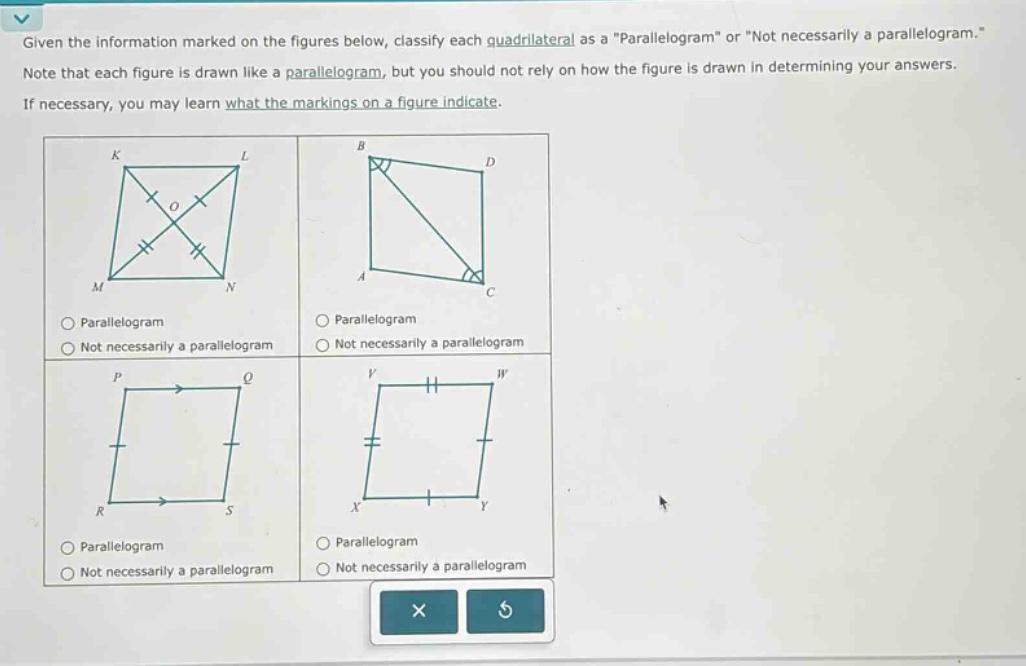
given the information marked on the figures below, classify each quadrilateral as a \parallelogram\ or \not necessarily a parallelogram.\ note that each figure is drawn like a parallelogram, but you should not rely on how the figure is drawn in determining your answers. if necessary, you may learn what the markings on a figure indicate.
Answer
Explanation:
Step1: Recall parallelogram - diagonals property
In a parallelogram, the diagonals bisect each other. In the first figure with quadrilateral (KLMN), the diagonals (KM) and (LN) are marked as bisecting each other ((KO = ON) and (LO=OM)). So, it is a parallelogram.
Step2: Recall angle - side relationship
In the second figure with quadrilateral (ABCD), we have (\angle ABC) and (\angle BCD) marked in a non - parallel - line - related way. Just having two adjacent angles marked does not guarantee parallel sides. So, it is not necessarily a parallelogram.
Step3: Recall parallel - sides property
In the third figure with quadrilateral (PQRS), we have (PQ\parallel RS) and (PQ = RS). One pair of opposite sides is parallel and equal, which is a property of a parallelogram. So, it is a parallelogram.
Step4: Recall side - side relationship
In the fourth figure with quadrilateral (VWXY), we have two pairs of adjacent sides marked as equal ((VX = XY) and (VW=WY)). This is the property of a kite, not a parallelogram. So, it is not necessarily a parallelogram.
Answer:
- Parallelogram
- Not necessarily a parallelogram
- Parallelogram
- Not necessarily a parallelogram