given that (overrightarrow{eb}) bisects (angle cea), which statements must be true? select three…
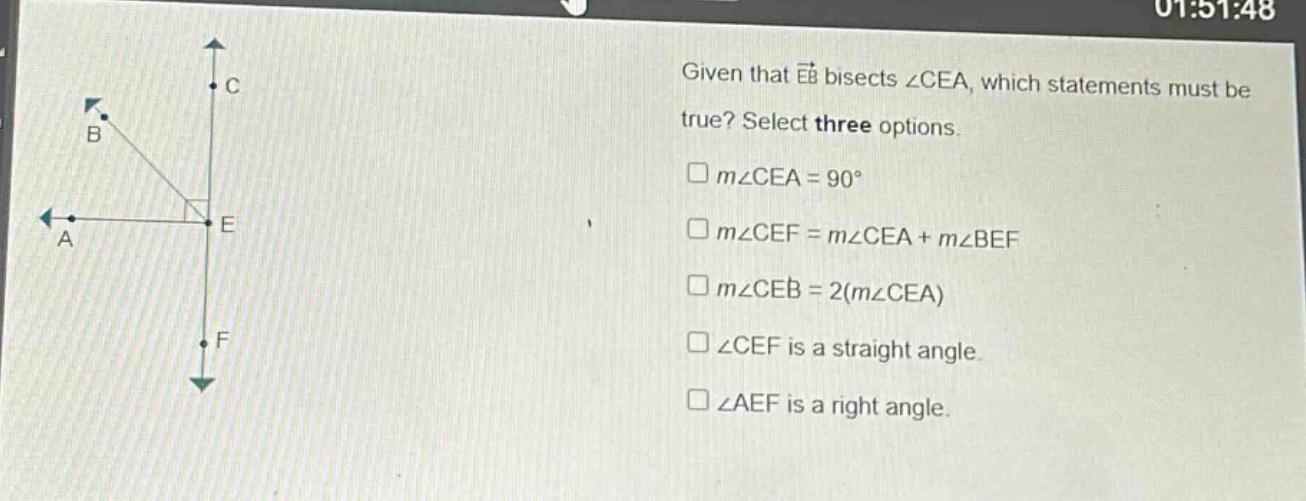
given that (overrightarrow{eb}) bisects (angle cea), which statements must be true? select three options.\n(square mangle cea = 90^{circ})\n(square mangle cef=mangle cea + mangle bef)\n(square mangle ceb = 2(mangle cea))\n(squareangle cef) is a straight angle.\n(squareangle aef) is a right angle.
Answer
Explanation:
Step1: Recall angle - bisector and angle - related definitions
An angle - bisector divides an angle into two equal parts. A straight angle measures 180°, and a right angle measures 90°.
Step2: Analyze each option
- Option 1: There is no information given to suggest that (m\angle CEA = 90^{\circ}), so this is not necessarily true.
- Option 2: (m\angle CEF=m\angle CEA + m\angle AEF), not (m\angle CEA + m\angle BEF), so this is false.
- Option 3: Since (\overrightarrow{EB}) bisects (\angle CEA), (m\angle CEB=\frac{1}{2}(m\angle CEA)), not (m\angle CEB = 2(m\angle CEA)), so this is false.
- Option 4: Since points (C), (E), and (F) are collinear, (\angle CEF) is a straight angle. By the definition of a straight - angle (an angle whose measure is 180°), this statement is true.
- Option 5: Since (\angle AEF) and the right - angle at (E) (formed by the perpendicular lines) are vertical angles, (\angle AEF) is a right angle. Vertical angles are congruent, and if one of the angles formed by two perpendicular lines is 90°, then its vertical angle is also 90°.
Answer:
(\angle CEF) is a straight angle, (\angle AEF) is a right angle.