given the vectors a and b, sketch the vector a + b. choose the correct sketch of a + b below. a. b. c. d.
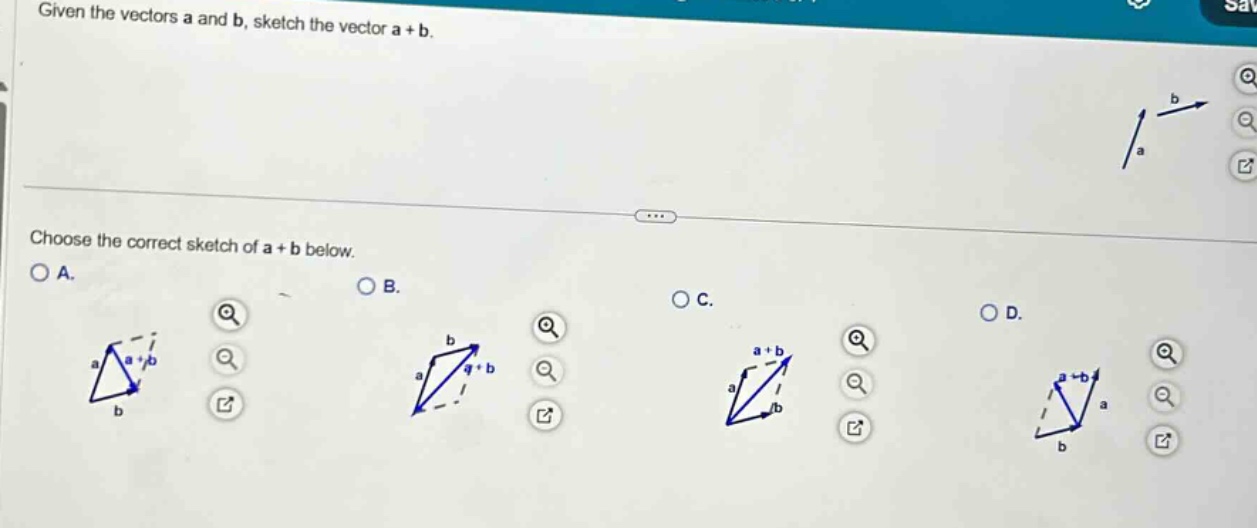
given the vectors a and b, sketch the vector a + b. choose the correct sketch of a + b below. a. b. c. d.
Answer
Explanation:
Step1: Recall vector - addition rule
The parallelogram law or the triangle law of vector addition is used. For the triangle law, if we have two vectors $\mathbf{a}$ and $\mathbf{b}$, to find $\mathbf{a}+\mathbf{b}$, we place the tail of $\mathbf{b}$ at the head of $\mathbf{a}$. Then the vector from the tail of $\mathbf{a}$ to the head of $\mathbf{b}$ is $\mathbf{a}+\mathbf{b}$. For the parallelogram law, we place the tails of $\mathbf{a}$ and $\mathbf{b}$ together, complete the parallelogram, and the diagonal starting from the common - tail of $\mathbf{a}$ and $\mathbf{b}$ is $\mathbf{a}+\mathbf{b}$.
Step2: Analyze each option
In option A, the vector $\mathbf{a}+\mathbf{b}$ is drawn incorrectly as the direction of the resultant is wrong according to the triangle law. In option B, the resultant vector is drawn such that it does not follow the correct vector - addition rule. In option C, if we place the tail of $\mathbf{b}$ at the head of $\mathbf{a}$ (or use the parallelogram law with the tails of $\mathbf{a}$ and $\mathbf{b}$ together), the vector $\mathbf{a}+\mathbf{b}$ is drawn correctly. In option D, the resultant vector is drawn in the wrong direction.
Answer:
C.