at a glance, kendra believes that the function represented on the graph is linear. how can kendra determine…
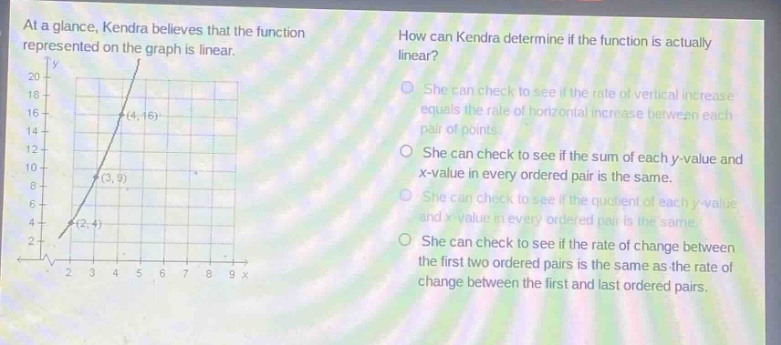
at a glance, kendra believes that the function represented on the graph is linear. how can kendra determine if the function is actually linear? she can check to see if the rate of vertical increase equals the rate of horizontal increase between each pair of points. she can check to see if the sum of each y - value and x - value in every ordered pair is the same. she can check to see if the quotient of each y - value and x - value in every ordered pair is the same. she can check to see if the rate of change between the first two ordered pairs is the same as the rate of change between the first and last ordered pairs.
Answer
Answer:
She can check to see if the rate of vertical increase equals the rate of horizontal increase between each pair of points.
Explanation:
Step1: Recall linear - function property
A linear function has a constant slope.
Step2: Define slope
Slope (m=\frac{\text{vertical change}}{\text{horizontal change}}=\frac{\Delta y}{\Delta x}).
Step3: Analyze options
- Option 1: Checking if the rate of vertical increase (change in (y)) equals the rate of horizontal increase (change in (x)) between each pair of points is equivalent to checking if the slope is constant, which is the characteristic of a linear function.
- Option 2: The sum of (x) - value and (y) - value in an ordered pair has no relation to linearity. For example, in ((1,2)) the sum is (3), in ((2,3)) the sum is (5), and this sum is not constant for linear functions.
- Option 3: The quotient of (y) - value and (x) - value ((\frac{y}{x})) is not related to the linearity of a function. For a non - proportional linear function (y = mx + b) ((b\neq0)), (\frac{y}{x}) is not constant.
- Option 4: Just comparing the rate of change between the first two and the first and last ordered pairs is not sufficient. The rate of change must be constant between all pairs of points for the function to be linear.