graham uses a 10 by 10 grid to model a decreasing pattern. he cuts off a section representing a percent of…
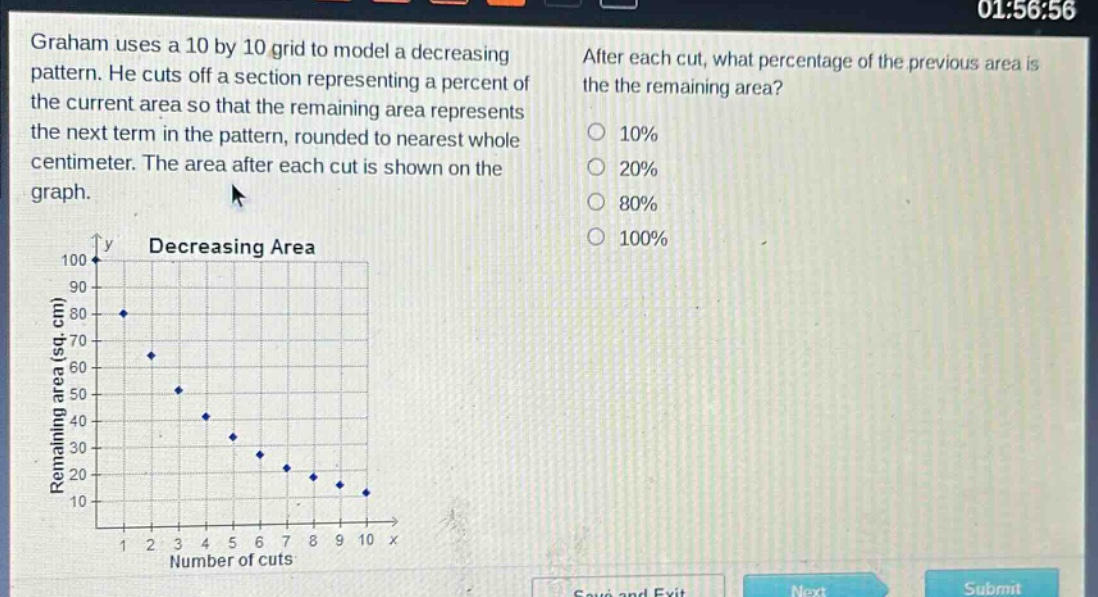
graham uses a 10 by 10 grid to model a decreasing pattern. he cuts off a section representing a percent of the current area so that the remaining area represents the next term in the pattern, rounded to nearest whole centimeter. the area after each cut is shown on the graph. after each cut, what percentage of the previous area is the remaining area? 10% 20% 80% 100%
Answer
Answer:
C. 80%
Explanation:
Step1: Observe the trend
As the number of cuts increases, the remaining - area decreases.
Step2: Analyze the ratio
If we assume the initial area is (A_0) and the area after the first cut is (A_1), and we take two - consecutive points on the graph. For example, if the initial area (when (x = 1)) is around 80 and after one more cut ((x = 2)) it is around 64. The ratio (\frac{A_1}{A_0}=\frac{64}{80}=0.8 = 80%). So the percentage of the previous area that the remaining area represents is 80%.