the graph of f(x) = 6(0.25)^x and its reflection across the y - axis, g(x), are shown. what is the domain of…
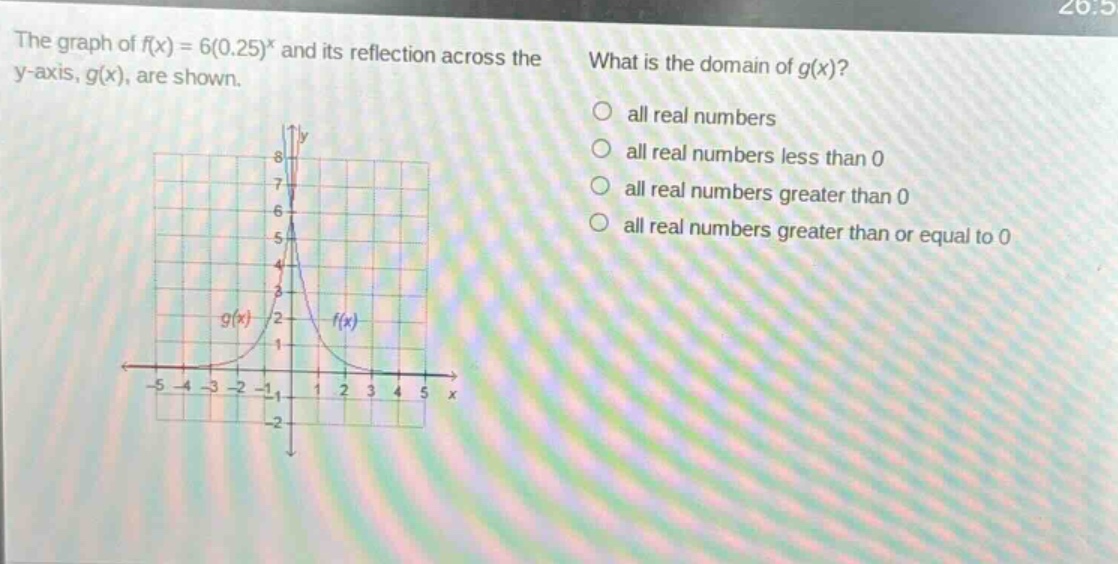
the graph of f(x) = 6(0.25)^x and its reflection across the y - axis, g(x), are shown. what is the domain of g(x)? all real numbers all real numbers less than 0 all real numbers greater than 0 all real numbers greater than or equal to 0
Answer
Explanation:
Step1: Recall domain definition
The domain of a function is the set of all possible input - values (x - values).
Step2: Analyze reflection across y - axis
When a function is reflected across the y - axis, the domain of the original function (f(x)) and its reflection (g(x)) is not restricted by the reflection operation. For an exponential function of the form (y = a(b)^x) (in this case (f(x)=6(0.25)^x) and (g(x)) is its y - axis reflection), there are no values of (x) for which the function is undefined.
Answer:
all real numbers