how does the graph of y = 3^x compare to the graph of y = 3^(-x)?\nthe graphs are the same.\nthe graphs are…
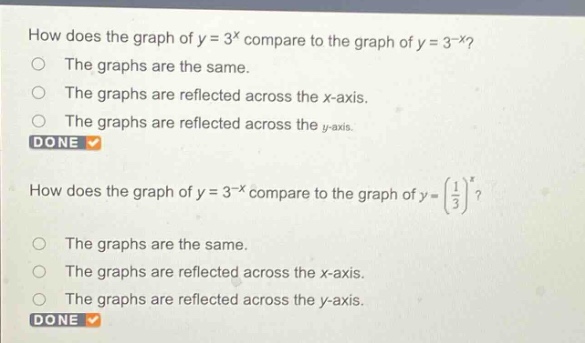
how does the graph of y = 3^x compare to the graph of y = 3^(-x)?\nthe graphs are the same.\nthe graphs are reflected across the x - axis.\nthe graphs are reflected across the y - axis.\ndone\nhow does the graph of y = 3^(-x) compare to the graph of y=(1/3)^x?\nthe graphs are the same.\nthe graphs are reflected across the x - axis.\nthe graphs are reflected across the y - axis.\ndone
Answer
Brief Explanations:
For the first comparison, when we change (y = 3^{x}) to (y=3^{-x}), we replace (x) with (-x). According to the transformation rules of functions, replacing (x) with (-x) in a function (y = f(x)) results in a reflection of the graph of (y = f(x)) across the (y -)axis. For the second comparison, we know that (3^{-x}=\left(\frac{1}{3}\right)^{x}) by the negative - exponent rule (a^{-n}=\frac{1}{a^{n}}). So the graphs of (y = 3^{-x}) and (y=\left(\frac{1}{3}\right)^{x}) are the same.
Answer:
- The graphs are reflected across the y - axis.
- The graphs are the same.