graph the equation.\ny = -|x|
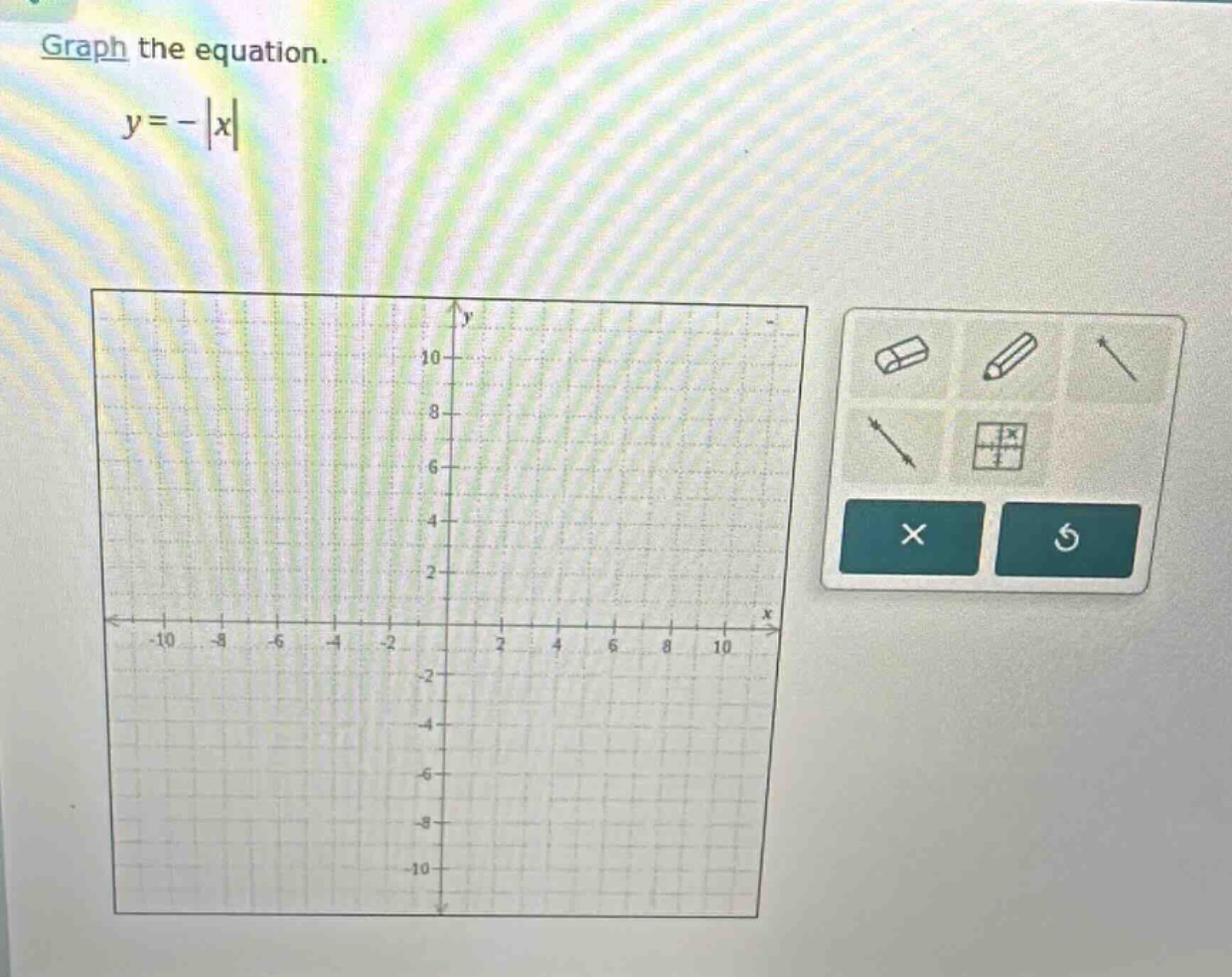
graph the equation.\ny = -|x|
Answer
Explanation:
Step 1: Analyze the base absolute value function
The parent function ( y = |x| ) is a V-shaped graph with vertex at ((0,0)), opening upward.
Step 2: Apply the negative sign transformation
The negative sign in ( y = -|x| ) reflects the graph of ( y = |x| ) over the ( x )-axis, flipping it to open downward.
Step 3: Determine key points
For ( x \geq 0 ), ( y = -x ) (slope = -1); for ( x < 0 ), ( y = -(-x) = x ) (slope = -1, since negative times negative is positive but overall negative sign remains? Wait, no: for ( x < 0 ), ( |x| = -x ), so ( y = -|x| = -(-x) = x ). Wait, no, that's incorrect. Correct: when ( x < 0 ), ( |x| = -x ), so ( y = -|x| = -(-x) = x ). But slope for ( x < 0 ) is 1? No, wait, let's take x = -2: |x| = 2, y = -2. So for x negative, y = -|x| = -(-x) = x? No, x = -2, |x| = 2, y = -2. So for x < 0, let x = -a where a > 0, then y = -a. So y = -a = x (since x = -a). So yes, for x < 0, y = x, which is a line with slope 1. Wait, but when x is positive, x = a > 0, y = -a, so slope -1. So left side (x < 0) has slope 1, right side (x ≥ 0) has slope -1, vertex at (0,0), opening downward.
Correcting Step 3: For ( x \geq 0 ), ( y = -x ) (slope = -1); for ( x < 0 ), ( y = x ) (slope = 1). Both meet at vertex (0,0).
Step 4: Plot the graph
Draw two straight lines: from (0,0) with slope -1 for ( x \geq 0 ) and slope 1 for ( x < 0 ), forming a downward-opening V with vertex at the origin.
Answer:
The graph is a downward-opening V-shape with vertex at the origin (0,0), where for ( x \geq 0 ) it follows the line ( y = -x ) and for ( x < 0 ) it follows the line ( y = x ).